
Table of Contents
The freight tendering process helps businesses choose carriers with the right cost, capacity, compliance, and service quality. It turns transport buying into a controlled commercial process, not a last-minute price hunt. For shippers, this matters because freight costs can change quickly, capacity can tighten, and poor carrier performance can damage customer trust.
In 2026, procurement teams face real pressure. UK logistics commentary reported a 4% fall in hauliers during 2025, while energy costs and part-load demand increased. That makes carrier selection more strategic, especially for firms moving regular pallet, parcel, container, or full-load freight.
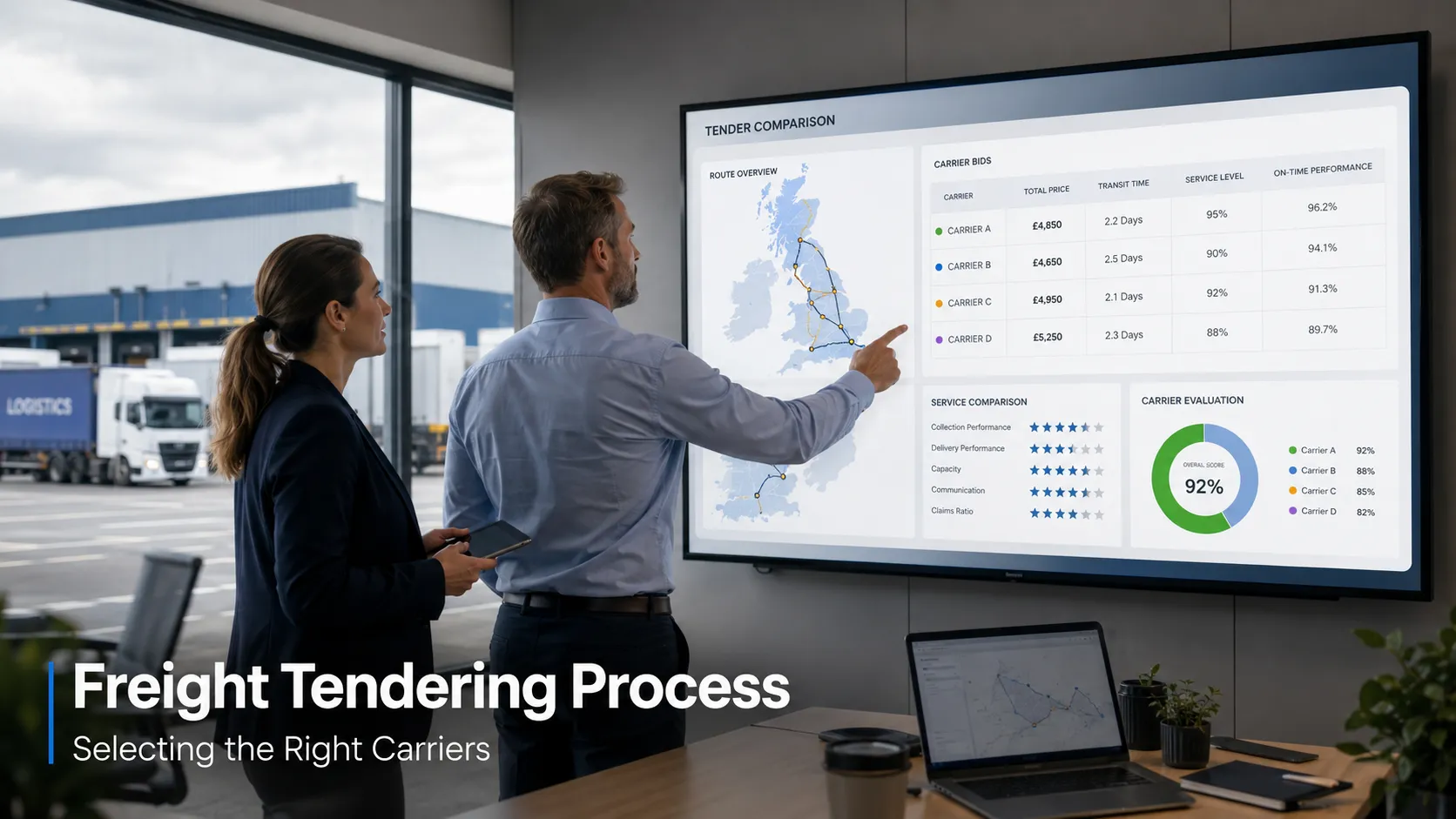
A good freight tendering process compares more than rates. It checks delivery accuracy, safety, fleet fit, technology, claims history, and escalation support. SAP describes tendering as requesting one or more carriers to quote for a defined freight order. That simple definition shows the core aim: match the right carrier to the right transport need.
What Is the Freight Tendering Process?
How Carrier Tendering Works in Practice
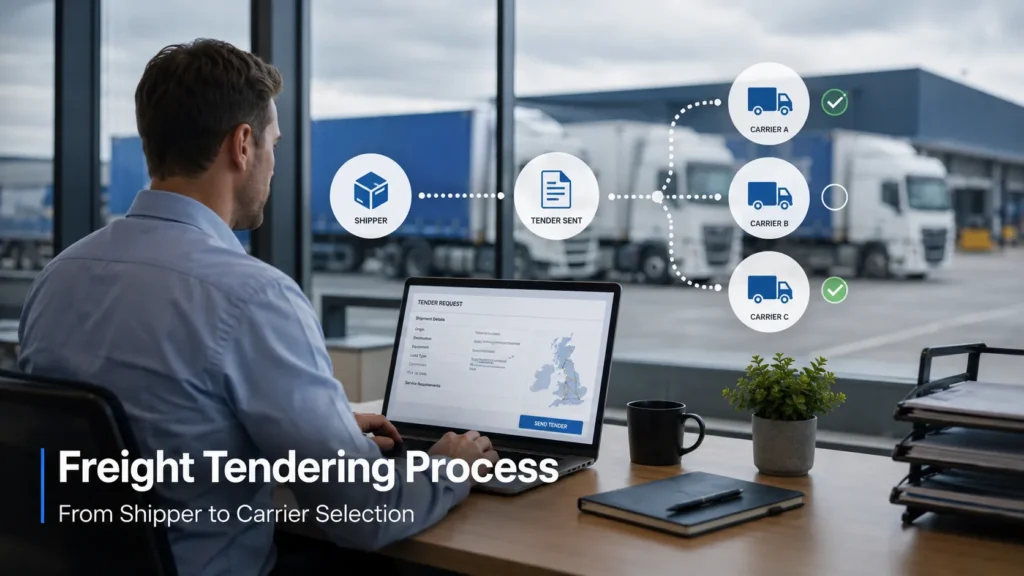
The freight tendering process is a structured method for inviting carriers to bid for transport work. A shipper shares lanes, volumes, service rules, collection windows, and required documents. Carriers then submit prices, capacity limits, operating models, and service commitments.
Strong tenders usually cover at least 12 months of expected freight demand. That gives carriers enough volume clarity to price properly. For seasonal businesses, buyers should include monthly shipment patterns. A retailer moving 2,000 pallets in November needs a different capacity than one moving 500 pallets in March.
The carrier tender stage can be manual, email-based, or run through a transport management system. Digital tools reduce errors because they keep rates, fuel rules, accessorial charges, and service notes in one format. That matters when teams compare 10 to 30 carriers across many lanes.
Why Freight Procurement Needs a Tender

Cost Control Starts With Clean Data
Effective freight procurement starts before the first quote arrives. Buyers need clean shipment data, including origin, destination, weight, cube, loading rules, waiting time, and delivery windows. Without that detail, carriers add risk to their prices.
A tender should normally include 6 to 12 months of shipment history. It should also separate spot work from regular lanes. Regular lanes help carriers plan vehicles and drivers. Spot lanes usually cost more because the carrier carries more uncertainty.
Market volatility makes this discipline more important. CIPS research cited by The Guardian found 22% of procurement professionals reported shipping cost increases above 10% by late 2025. That shows why buyers need structured comparison, not casual quote chasing.
Key Stages in the Freight Tendering Process
From Scope to Award
A strong freight tendering process follows a clear sequence. Each stage reduces risk and improves carrier comparison. The process should feel simple, but the data must be detailed.
| Stage | Main Action | Output | Practical Target |
|---|---|---|---|
| 1. Scope | Define lanes, modes, volumes, and rules | Tender pack | 100% lane coverage |
| 2. Invite | Shortlist suitable carriers | Bid list | 5–15 carriers per mode |
| 3. Clarify | Answer carrier questions | Shared Q&A log | Reply within 48 hours |
| 4. Evaluate | Compare cost, service, and risk | Scorecard | Weighted score out of 100 |
| 5. Negotiate | Finalise rates and service terms | Best and final offer | 2–3 finalist carriers |
| 6. Award | Allocate lanes and backup carriers | Contract award | Primary and secondary cover |
| 7. Review | Track KPIs after go-live | Performance dashboard | Monthly review cycle |
This table reflects a practical tender model we use when planning B2B logistics content. The strongest tenders always keep cost, service, and operational fit separate. That prevents the cheapest bid from winning when the service risk is high.
How Businesses Score Carrier Tender Responses

Price Should Not Carry the Whole Decision
Carrier selection works best when each bid receives a weighted score. A simple model might give 40% to price, 25% to service performance, 15% to capacity, 10% to technology, and 10% to compliance. This keeps the decision commercial, but not reckless.
For example, a carrier charging £118 per pallet with 97% on-time delivery may beat a carrier charging £112 with 91% on-time delivery. The cheaper option can create failed delivery costs, customer complaints, and rebooking time.
Useful tender scoring criteria include:
- Rate per lane, fuel surcharge, waiting time, and cancellation fees.
- On-time collection and on-time delivery performance.
- Fleet type, depot coverage, and peak-season capacity.
- Claims ratio, insurance level, and safety record.
- Tracking tools, EDI/API access, and proof-of-delivery speed.
- Account management, escalation cover, and review cadence.
Logistics KPI guidance commonly tracks delivery accuracy, transport cost, delivery time, and punctuality. These metrics fit naturally into a carrier scorecard.
What to Include in a Transport Tender Pack

Better Inputs Create Better Carrier Bids
A transport tender pack should make the carrier’s job easy. It should include lane files, shipment profiles, service rules, payment terms, and contract expectations. The more complete the pack, the lower the pricing risk.
A strong tender pack includes these details:
- Collection and delivery postcodes.
- Pallet counts, weights, dimensions, and stackability.
- Loading type, booking rules, and site restrictions.
- Delivery windows and weekend requirements.
- Historic shipment volumes by month.
- Fuel surcharge method and review dates.
- Claims process and minimum insurance cover.
- Required technology, including tracking and POD.
- Service credits, penalties, and dispute rules.
Businesses should avoid vague lines such as “regular UK deliveries”. A better line says, “320 pallets per month from Birmingham B24 to Manchester M17, Monday to Friday, 08:00–16:00 delivery window.” That level of detail helps carriers price work correctly.
Common Mistakes in Freight Tendering
Low Prices Can Hide High Risk
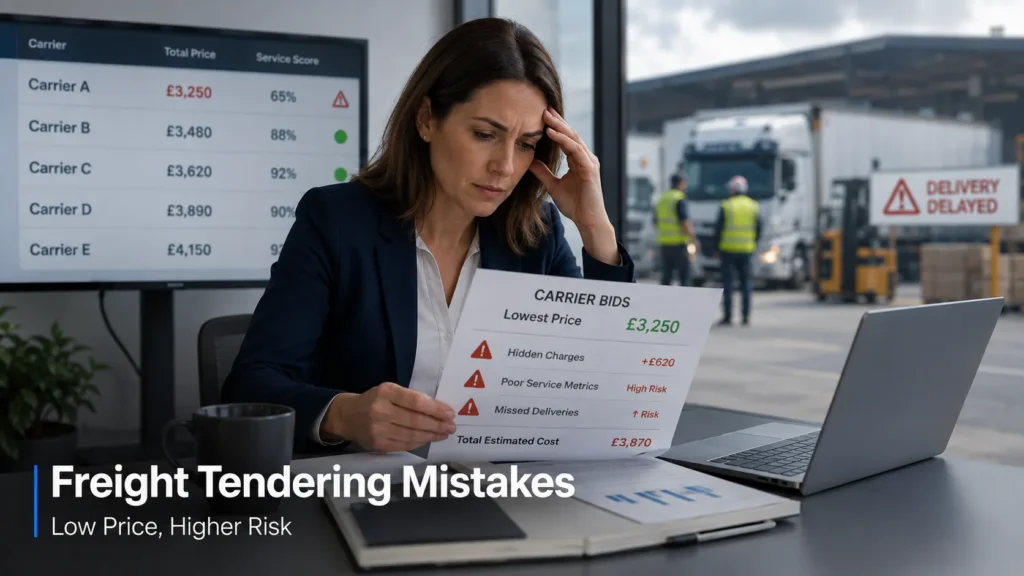
Many businesses weaken the freight tendering process by chasing the lowest rate too quickly. That creates hidden problems after launch. A carrier may win lanes, then reject loads because the price does not cover real operating costs.
Another mistake is ignoring backup capacity. Every key lane should have a secondary carrier. A good rule is to place 70% to 80% of volume with the primary carrier and keep 20% to 30% available for backup or market testing. This protects service during driver shortages, weather delays, and peak trading weeks.
Businesses also forget to lock in accessorial charges. Waiting time, tail-lift fees, failed delivery charges, demurrage, and redelivery fees can change the true cost. A rate that looks 5% cheaper can become more expensive after these charges.
Contracting and Onboarding Selected Carriers

The Award Is Not the Finish Line
The freight tendering process does not end when a carrier wins. Onboarding decides whether the award creates real value. The buyer should confirm rate cards, depot contacts, invoicing rules, booking cut-offs, and escalation paths before go-live.
A practical onboarding checklist should include 10 working days for system setup. That gives time to test labels, EDI messages, tracking links, and proof-of-delivery flows. It also reduces failed collections during the first week.
Quarterly business reviews should start from month three. Teams should review cost per shipment, on-time delivery, load acceptance, claims, and invoice accuracy. If performance falls below the target for 2 consecutive months, the shipper should trigger a corrective action plan.
Best KPIs for Carrier Performance
Measure What Affects Customers and Cost
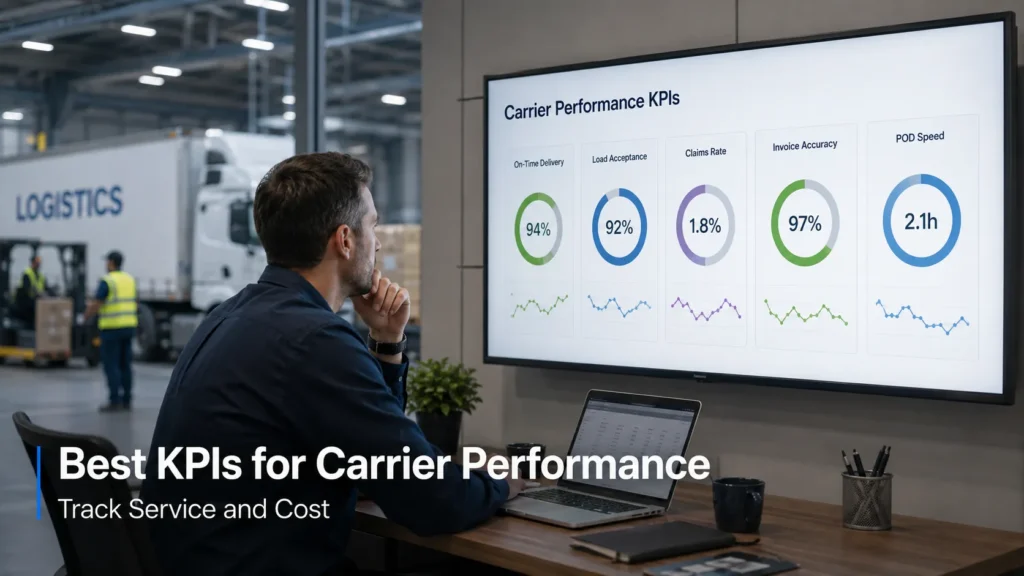
Carrier KPIs should connect directly to customer experience and operating cost. Too many dashboards track activity, not performance. A focused dashboard works better for senior teams and transport planners.
Core KPIs include:
- On-time collection: target 98%.
- On-time delivery: target 96% to 98%.
- Load acceptance: target 95%.
- Claims rate: below 0.5% of shipments.
- Invoice accuracy: target 99%.
- POD availability: within 24 hours.
- Failed delivery rate: below 2%.
These numbers are practical operating benchmarks, not legal standards. They give businesses a clear baseline when comparing carriers. They also support fair conversations because both sides know how success is measured.