

Table of Contents
To compare freight quotes well, we need to look beyond the lowest number on the page. A cheap quote can become expensive once fuel, waiting time, customs delays, failed delivery, storage, or poor communication are factored in. In May 2026, Drewry’s World Container Index reached $2,800 per 40ft container, after a 3% weekly rise, showing how quickly market pricing can move. Shanghai-to-Rotterdam rates also rose 3%, reaching $2,861 per 40ft container.
Strong buying decisions start with a clear quote comparison process. We should check the service level, route, transit time, liability cover, accessorial charges, and carrier reliability before signing. This approach improves shipping cost control and reduces operational risk. It also helps procurement teams avoid false savings that damage delivery performance. When we compare freight quotes properly, we protect margin, customer trust, and supply chain continuity.
Why the Lowest Freight Quote Can Cost More
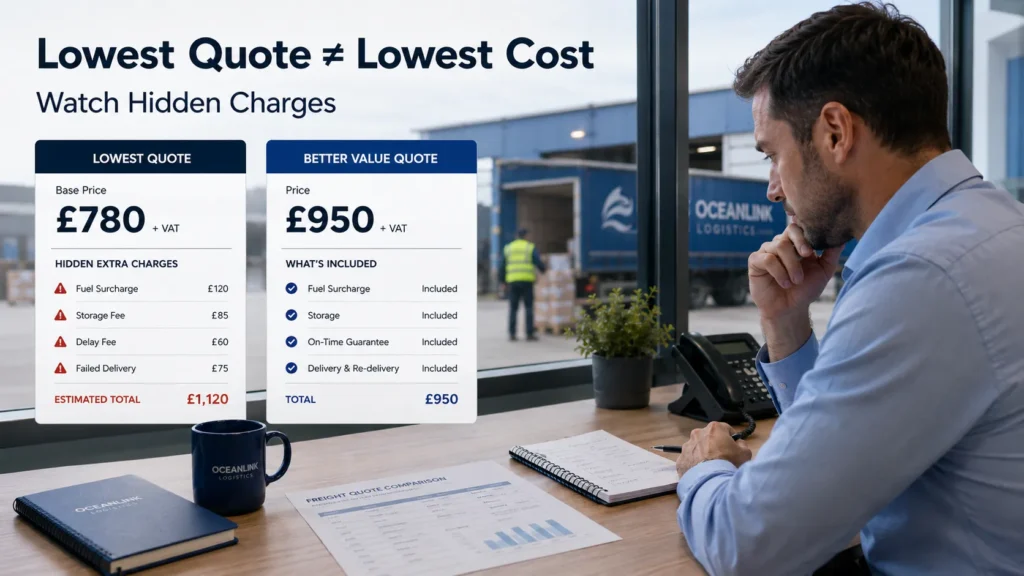
Cheap freight pricing often hides service gaps
A low quote can look attractive, but it may exclude important service items. Fuel surcharge, collection waiting time, tail-lift use, port charges, customs handling, storage, and weekend delivery can change the final invoice. Accessorial charges such as detention, demurrage, reconsignment, and liftgate fees can add real cost when shipment details are unclear. Some 2025 market guides list detention at $50–$150 per hour and demurrage at $150–$500 per day, depending on carrier and mode.
Strong teams compare the full landed transport cost, not only the headline rate. We should ask each carrier to quote using the same lane, weight, dimensions, Incoterms, commodity type, delivery window, and insurance requirement. This keeps freight pricing fair and measurable. If one quote is 18% cheaper but excludes customs clearance, it may not be cheaper at all. That difference can quickly disappear after one delay.
Wrong carrier choice creates hidden business costs
A poor carrier can create missed delivery slots, rejected loads, damaged goods, and unhappy customers. These costs rarely appear in the first quote, but they hit the business later. A missed retail delivery can create penalty charges, rebooking fees, warehouse congestion, and emergency re-delivery. In e-commerce, one failed delivery can also trigger refunds, support tickets, and negative reviews.
We should compare freight quotes against service history, not price alone. Ask for on-time delivery performance, claims ratio, fleet coverage, subcontractor use, tracking quality, and escalation support. A carrier with 96% on-time delivery may beat a cheaper carrier with weak communication. The best freight quote balances cost, control, and reliability.
How to Compare Freight Quotes Line by Line
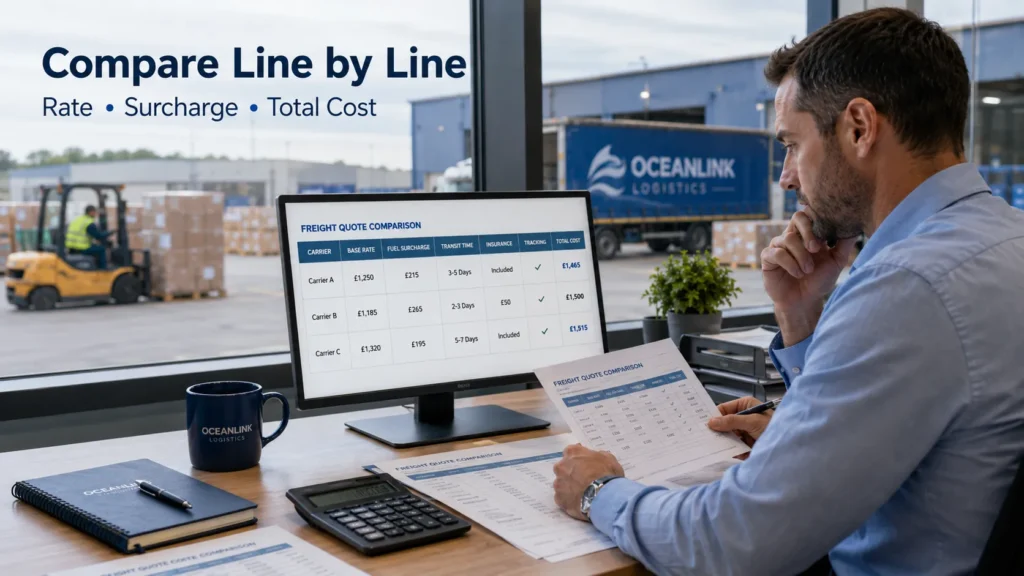
Standardise shipment details before requesting prices
A quote comparison only works when every carrier prices the same job. We should prepare a standard shipment brief before asking for rates. Include collection postcode, delivery postcode, pallet count, gross weight, dimensions, stackability, commodity description, hazard status, temperature needs, value of goods, and required delivery date. This removes guesswork and prevents carriers from adding assumptions.
When we compare freight quotes, every missing detail creates price risk. A carrier may quote for curbside delivery, while another includes inside delivery. One may include customs paperwork while another treats it as extra. One may assume business-hours delivery, while another includes booked-in delivery. Standardising details supports logistics cost reduction because it reduces avoidable billing disputes.
Compare base rate, surcharge, and total cost
A proper quote review separates the base freight rate from variable charges. The base rate covers the main transport movement. Surcharges cover changing costs or special handling. These may include fuel, congestion, security, peak season, port fees, documentation, waiting time, and remote-area delivery. Container markets remain volatile, with the World Container Index up 26.35% over one month on 28 May 2026.
We should ask each carrier for a total “all-in” quote and a full charge breakdown. This gives us two views. The all-in number shows the likely invoice. The breakdown shows where the risk sits. If the fuel surcharge is variable, ask which index applies and when it updates. Clear surcharge rules strengthen shipping cost control and prevent invoice shocks.
Freight Quote Comparison Table
| Quote Item | What to Check | Why It Matters | Red Flag |
|---|---|---|---|
| Base freight rate | Lane, mode, weight, dimensions | Confirms core transport cost | Very low rate with vague scope |
| Fuel surcharge | Index, percentage, review date | Protects cost accuracy | “Fuel extra” with no formula |
| Transit time | Door-to-door days or hours | Supports customer promises | No guaranteed delivery window |
| Accessorial charges | Waiting, storage, tail-lift, demurrage | Prevents hidden costs | Charges missing from quote |
| Carrier cover | Liability limit and claims process | Protects high-value goods | No written claims process |
| Tracking | Milestone updates or live tracking | Improves visibility | Manual updates only |
| Customs support | Entries, documents, duties guidance | Reduces border delays | “Customs not included” unclear |
| Subcontracting | Own fleet or partner network | Controls accountability | Carrier will not disclose partners |
| Payment terms | Credit days, deposits, extras | Helps cash flow planning | Extra fees after acceptance |
| Service history | On-time rate and references | Reduces delivery risk | No performance data shared |
Build a Freight Quote Checklist Before You Decide

Use a practical checklist for buying decisions
A checklist keeps the quote review fair, fast, and repeatable. It also helps teams defend their choice when finance asks why the lowest price was rejected. We should score each carrier across cost, service, risk, and support. A simple 100-point model works well for most shippers.
Use this quote checklist when you compare freight quotes:
- 30 points: Total cost, including surcharges and accessorial charges.
- 20 points: Transit time, delivery reliability, and service fit.
- 15 points: Tracking, communication, and escalation support.
- 15 points: Insurance, liability, claims handling, and compliance.
- 10 points: Customs knowledge and documentation support.
- 10 points: Capacity, coverage, and carrier stability.
This scoring method supports logistics cost reduction without choosing risky carriers. It also creates a clear record for future tenders.
Ask carriers direct questions before approval
Strong questions reveal weak quotes quickly. Ask whether the quote is fixed or subject to market review. Ask how long the price remains valid. Ask what happens if the shipment weight changes by 5% or one extra pallet appears. Ask whether delivery appointments, tail-lift, timed delivery, port storage, or customs entries are included.
We should also ask who handles exceptions after office hours. This matters because logistics problems rarely wait for convenient times. A carrier with a clear escalation path can save hours during a disruption. When we compare freight quotes, service support is part of the price. A cheap carrier with poor escalation can create a higher total cost.
Freight Pricing Factors That Change the Final Quote

Weight, cube, distance, and speed drive cost
Freight pricing depends on physical and operational factors. Weight affects vehicle capacity, fuel use, and handling. Cube affects space on trailers, containers, and aircraft. Distance affects fuel, driver time, tolls, and equipment use. Speed affects planning flexibility. Express freight often costs more because carriers must prioritise capacity and reduce consolidation options.
Mode also changes the cost profile. Road freight gives flexible door-to-door delivery. Sea freight offers a lower cost for bulk international goods. Air freight supports urgent shipments but usually carries a premium. Rail and intermodal can reduce costs on suitable corridors. We should compare freight quotes by matching mode to business need, not habit.
Market conditions can move rates quickly
Freight markets can change due to fuel, labour, capacity, port congestion, geopolitics, and seasonal demand. In May 2026, Reuters reported major disruption around the Strait of Hormuz, with energy vessel flows falling from about 70 vessels per day to fewer than 7 per day during the crisis. It also reported crude shipments down by about 71 million tonnes, or 8%.
These disruptions matter because fuel and capacity affect freight pricing. Even domestic road freight can feel pressure when fuel markets move. That is why quote validity matters. A quote valid for 7 days carries a different risk from one valid for 30 days. Strong shipping cost control needs both price checks and timing discipline.
Common Mistakes When Comparing Freight Quotes

Mistake 1: Comparing different service levels
The most common mistake is comparing two different services as if they are equal. One quote may include booked delivery, tracking, and customs support. Another may only include basic port-to-port movement. The lower price wins on paper but loses in practice. This mistake damages logistics cost reduction because it shifts cost into operations.
Create a like-for-like comparison sheet before choosing. Use the same shipment data and require the same service scope. If a carrier cannot match the scope, note this clearly. Do not let incomplete quotes compete with complete ones.
Mistake 2: Ignoring accessorial charges
Accessorial charges often decide the true cost. Waiting time, failed delivery, storage, detention, demurrage, tail-lift, residential delivery, and re-delivery can change the invoice. These charges grow when teams book freight with incomplete details. They also grow when warehouses miss loading slots or customers are unavailable.
Build accessorial review into every quote. Ask for rates per hour, per day, per pallet, or per event. Then estimate realistic exposure. If your warehouse has regular loading delays of 45 minutes, waiting time matters. When we compare freight quotes, the best choice is the quote with a predictable total cost.
Mistake 3: Choosing price without checking claims handling
Damage and loss can turn a cheap move into an expensive mistake. Check the carrier’s liability limit, insurance options, claim deadline, required evidence, and average claim resolution time. High-value shipments may need extra cover. Fragile goods may need special handling or packaging rules.
Ask for claims data where possible. A carrier that explains claims clearly usually understands risk. A carrier that avoids the topic may create problems later. Freight procurement should protect the goods, not just move them.
Expert Buying Advice for Better Logistics Cost Reduction

Use a three-quote rule with a scoring model
A practical procurement method is to request at least 3 comparable quotes for important shipments. This gives enough market visibility without slowing the team. For regular lanes, review pricing every 90 days or after major market movement. For spot shipments, compare quotes immediately because capacity and fuel can change fast.
Use a weighted score rather than gut feeling. Give cost the highest weight, but not the only weight. A balanced model improves logistics cost reduction because it avoids costly service failures. Our field experience shows the best freight decisions usually come from combining price, reliability, visibility, and exception handling.
Keep a carrier performance record
Freight buying improves when we track actual performance. Record quoted cost, final invoice, pickup time, delivery time, damage, delay reason, and communication quality. After 10 completed shipments, patterns become clear. Some carriers quote well but invoice poorly. Others cost more but deliver with fewer exceptions.
This original internal scorecard creates better future decisions. It also gives procurement evidence during rate reviews. When we compare freight quotes, past performance should influence the next award. The cheapest carrier should earn repeat work through results, not promises.