

Table of Contents
A strong Warehouse Location Strategy UK determines how quickly goods move, how much distribution costs, and how reliably customers receive orders. In 2026, logistics efficiency matters more than ever because UK e-commerce continues to expand. The Office for National Statistics reports that online retail accounted for 26.9% of total retail sales in 2025, increasing pressure on distribution networks.
Warehouse location decisions influence transport costs, labour access, and delivery times. Poor placement increases mileage, delays orders, and raises operational expenses. In contrast, strategic placement near transport corridors enables same-day or next-day delivery across the UK.
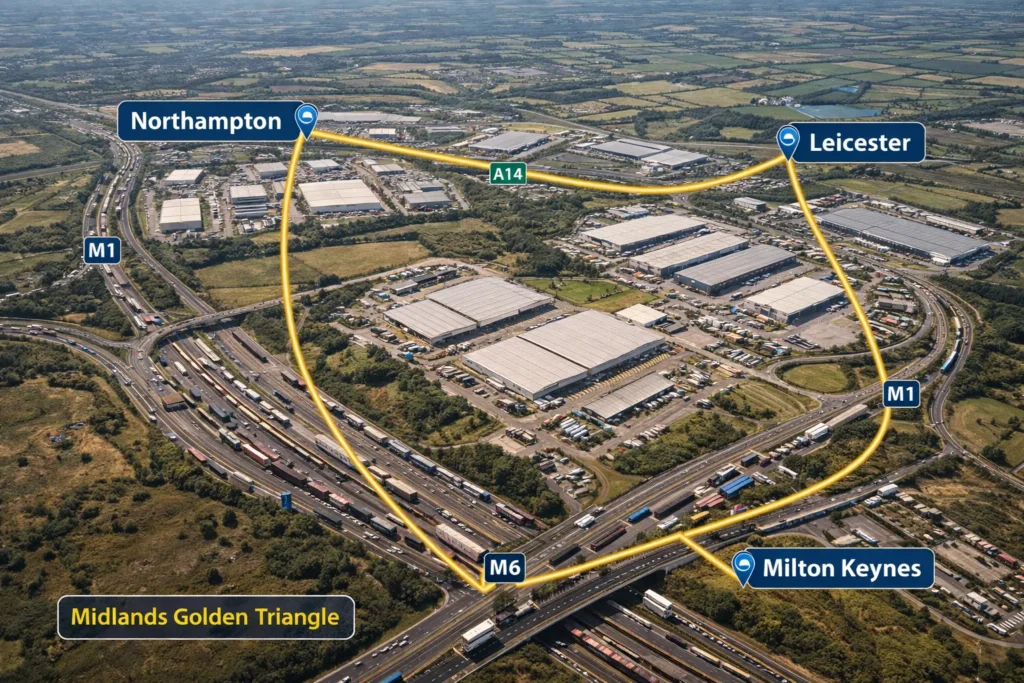
One area dominates discussions about optimal logistics positioning: the Midlands Golden Triangle. This region sits between Northampton, Leicester, and Milton Keynes, giving access to around 90% of the UK population within four hours of driving time. Major retailers and third-party logistics providers increasingly locate facilities here.
Why Warehouse Location Matters in UK Supply Chains

Transport Costs and Delivery Efficiency
Transport costs often represent the largest logistics expense. According to the UK Department for Transport, road freight moved 152 billion tonne-kilometres in 2024, highlighting heavy reliance on road distribution.
A smart Warehouse Location Strategy UK reduces the distance between warehouses and customers. Shorter journeys reduce fuel costs and delivery time. Businesses can also run fewer vehicles while maintaining high service levels.
Strategically located facilities also allow better route optimisation. Distribution hubs positioned near motorway intersections minimise congestion and simplify multi-destination deliveries. Companies operating nationwide benefit most from central warehouse locations.
Labour Availability and Workforce Stability
Warehouse operations depend heavily on labour availability. The UK logistics sector employs around 2.7 million workers as of 2025, according to Logistics UK. Access to skilled warehouse staff strongly influences facility placement.
Regions with established logistics clusters attract experienced workers. Areas with existing distribution hubs also offer training infrastructure and specialised recruitment networks.
Labour availability impacts operational scalability. During peak periods such as Christmas, companies must quickly increase workforce capacity. Locations with strong labour pools make seasonal scaling far easier.
The Midlands Golden Triangle: UK Logistics Hub
Geographic Advantages
The Midlands Golden Triangle sits in central England. It covers areas around Northamptonshire, Leicestershire, and Warwickshire. This location provides exceptional national coverage.
From this region, distribution networks reach most UK households within a single working shift. Industry studies show that around 90% of the UK population lives within four hours’ drive of this area.
The region also sits close to major motorways, including:
- M1 motorway
- M6 motorway
- M69 motorway
- A14 freight corridor
These transport links enable fast connections between ports, cities, and distribution centres. A centralised Warehouse Location Strategy UK built around the Golden Triangle significantly improves delivery efficiency.
Growth of Distribution Parks
The Midlands logistics corridor continues expanding rapidly. Large distribution parks now dominate areas around Daventry, Rugby, and Corby.
Examples include:
- Daventry International Rail Freight Terminal (DIRFT)
- Magna Park Lutterworth
- East Midlands Gateway
These developments provide millions of square metres of logistics space. They also integrate rail freight facilities, enabling multi-modal transport options.
Key Factors in a Warehouse Location Strategy UK

Proximity to Transport Infrastructure
Transport access remains the most critical factor in warehouse placement. Warehouses near motorway junctions allow faster vehicle movements and reduce congestion delays.
Companies should prioritise locations near:
- Major motorways
- Rail freight terminals
- International airports
- Seaports handling container imports
For example, proximity to the Port of Felixstowe or London Gateway improves import distribution efficiency. Businesses importing goods from Asia benefit from rapid inland transport.
When infrastructure aligns with distribution needs, supply chains operate far more efficiently.
Land Availability and Warehouse Space
Land availability directly affects warehouse size and scalability. Modern fulfilment centres require large plots, often exceeding 500,000 square feet.
Regions with limited land supply restrict expansion. High demand also increases property costs. In contrast, areas with large logistics parks provide space for future growth.
Midlands Golden Triangle Advantages
Faster Nationwide Delivery
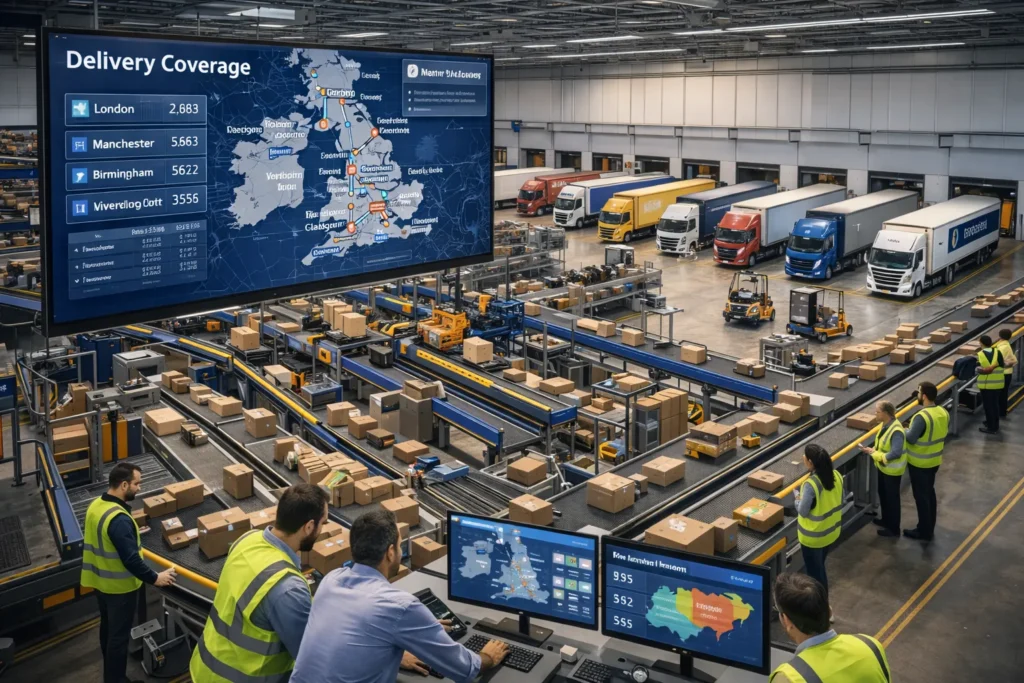
Central positioning dramatically reduces delivery distances. Logistics operators can reach most major cities quickly from the Midlands.
Typical delivery coverage from the region includes:
- London within 2–3 hours
- Birmingham within 1 hour
- Manchester within 2 hours
- Leeds within 2.5 hours
This central access enables same-day or next-day delivery across most of the UK.
Retailers rely heavily on this capability to meet rising customer expectations. Fast fulfilment improves customer satisfaction and competitive positioning.
Established Logistics Ecosystem
The Midlands hosts hundreds of distribution centres, creating a mature logistics ecosystem.
Benefits include:
- Large labour pools with logistics experience
- Access to multiple third-party logistics providers
- Established trucking and freight networks
- Specialist warehouse technology suppliers
Comparison of Key UK Warehouse Locations
| Region | Coverage Speed | Logistics Infrastructure | Land Availability | Typical Use |
|---|---|---|---|---|
| Midlands Golden Triangle | Excellent nationwide reach | Extensive motorway and rail hubs | High | National distribution centres |
| London & South East | Excellent consumer proximity | Congested road networks | Limited | Urban fulfilment hubs |
| North West England | Strong northern coverage | Good motorway links | Moderate | Regional distribution |
| Scotland Central Belt | Strong Scottish coverage | Limited national reach | Moderate | Regional warehouses |
Challenges When Choosing Warehouse Locations
Even strong locations present challenges. Logistics planners must evaluate several risks.
Key considerations include:
- Rising land prices in high-demand logistics areas.
- Increasing congestion on major motorway routes.\
- Planning permission restrictions for large facilities.
- Competition for warehouse labour.
For example, industrial land prices in the Midlands increased over 35% between 2021 and 2025, according to property market research.
Businesses must therefore balance strategic advantages with operational costs. Diversifying distribution networks can reduce regional dependency.
Bottom Line
A strong Warehouse Location Strategy UK directly determines distribution speed, operational costs, and supply chain resilience. Logistics networks work best when warehouses sit near transport infrastructure and major population centres.
The Midlands Golden Triangle remains the UK’s most strategic logistics region. Its central geography allows companies to reach around 90% of the population within four hours. Combined with extensive motorway networks and growing logistics parks, the region offers unmatched national coverage.