
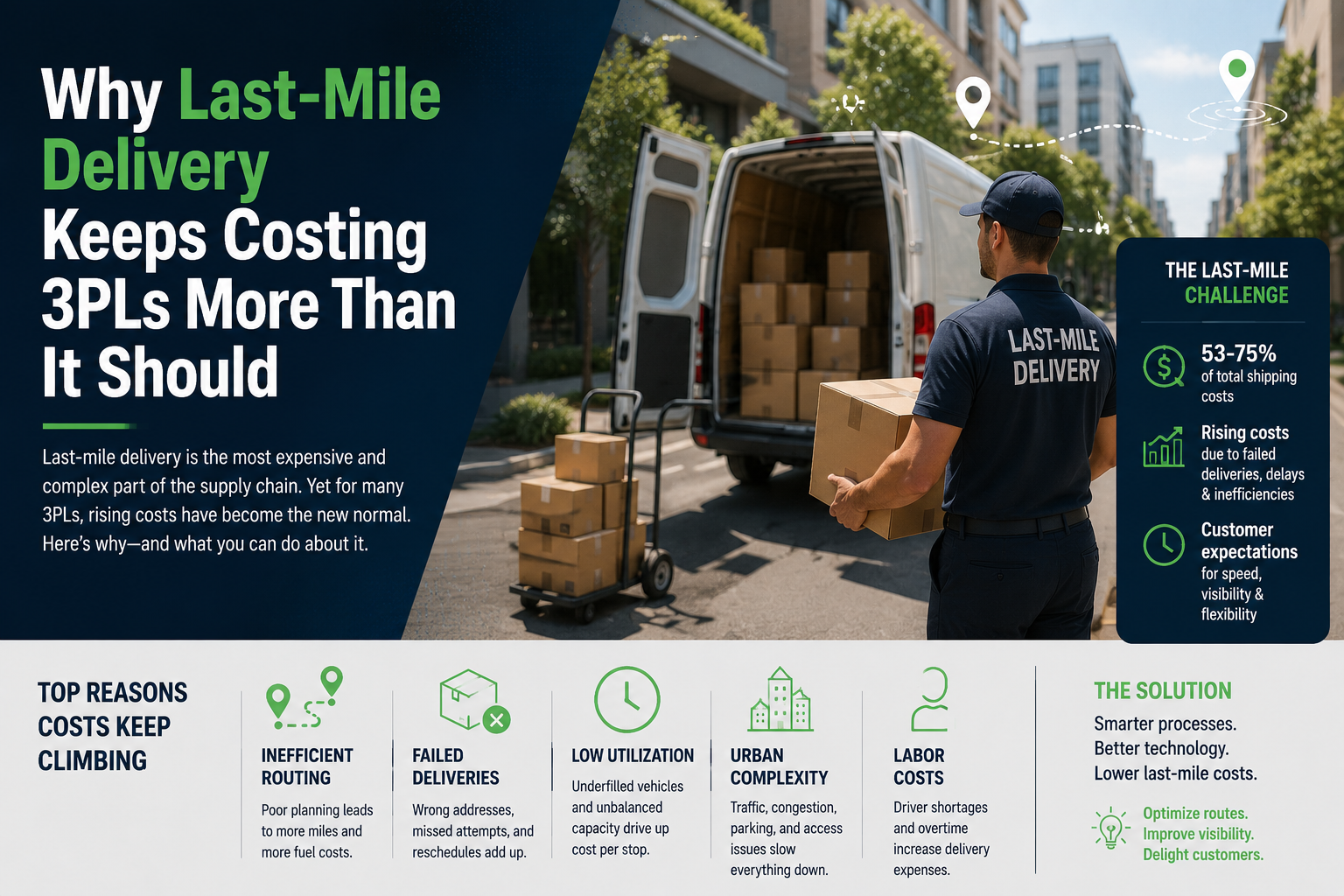
You run a mid-market 3PL — 50 to 500 routes a day, multiple carrier relationships, e-commerce and retail clients with tightening SLAs. You’ve optimized your warehouse. You’ve negotiated carrier rates. You’ve hired good people. And the last mile keeps bleeding money anyway.
That’s not a management failure. It’s a structural one — and it’s getting worse.
Last-mile delivery now accounts for up to 53% of total logistics costs, up from 41% just a few years ago. The final stretch from hub to doorstep is the shortest part of the journey and the most expensive to run.
Most 3PL leaders already know this. The harder question is whether technology can actually move the needle on problems that feel deeply operational — and where the real leverage is.
Quick answer before we get into the detail:
- Three problems — cost, failed deliveries, and route complexity — drive roughly 80% of last-mile losses for most mid-market 3PLs
- Software addresses five of the seven pain points on this list directly; two others it supports without fully solving
- The 3PLs compressing costs right now aren’t doing anything exotic — they’re implementing proven integrations in a specific sequence
- GoLocker (NYC package locker network, integrated with USPS/FedEx/UPS/DHL) is a working example of what this looks like when someone actually builds it
If you’re already past the “should we invest in tech” question and into “what do we build first,” jump to the roadmap section at the end.
Why Last-Mile Is Still Broken
Most 3PLs don’t have a people problem. They have a systems problem.
Last-mile isn’t a standalone issue. It sits inside a wider set of challenges facing the logistics industry — siloed operations, legacy system dependencies, data management gaps, shrinking margins — and each of those makes the last mile harder to fix. You can build the best route planning engine available, but if it can’t pull live data from a 15-year-old warehouse system, the optimization stops at the interface.
Here’s a pattern that shows up consistently: when a 3PL doubles its shipment volume, dispatch complexity doesn’t double — it grows roughly three to four times. A dispatcher managing 80 routes manually makes decent decisions. The same dispatcher at 300 routes is triaging, not optimizing. Support call volume spikes at the same rate, because more shipments mean more exceptions, and exceptions require manual handling when there’s no automation layer to catch them.
The industry’s default answer has been more people. That works up to a point, then it stops scaling entirely while costs keep compounding. Software doesn’t replace operational judgment. It makes that judgment executable at scale.
The 7 Biggest Pain Points — and What Software Can Do About Them
A note on prioritization: not all seven are equal. Problems 1, 2, and 4 — cost structure, failed deliveries, and routing complexity — are where most mid-market 3PLs have the largest addressable losses. Fix those three first and you’ll recover enough margin to fund the rest.
1. The High Cost of the Last Mile
The issue isn’t that last-mile is expensive — it’s that the costs are variable and invisible until you have data to expose them. Small batches, individual addresses, delivery windows, urban congestion, driver idle time: each adds cost that’s nearly impossible to reduce without systems generating the signal.
AI-driven route optimization can reduce logistics costs by 5–20%, according to McKinsey (2024 data, distribution operations). At scale, that’s the difference between a profitable route and a loss-making one. Modern routing engines optimize across hundreds of simultaneous constraints — vehicle capacity, driver shifts, live traffic, time windows, fuel cost — in seconds.
To make this concrete: a regional 3PL running 200 routes per day, with an average route cost of $85, that reduces cost per route by 8% through better optimization saves roughly $50,000 a year. That’s a realistic number from a realistic improvement. The software pays for itself well within the first year.
2. Failed Deliveries and Reverse Logistics
This is where most 3PLs undercount their losses.
A single failed delivery costs an average of $17.20 in the US in direct costs — the redelivery trip, the driver time, the fuel. But the real number is higher. Add customer service handling ($8–12 per inbound WISMO call), client SLA penalties where applicable, and the downstream churn risk when a brand’s end customer has a bad experience. The total cost of a failed delivery is closer to $35–50 when you count direct and indirect together.
At an industry-average first-attempt failure rate of around 8%, a 3PL processing 50,000 shipments a month is absorbing roughly 4,000 failures — somewhere between $68,000 and $200,000 a month depending on how you account for indirect costs. That’s the number that should be on the board, not just the $17 figure.
The causes are predictable and addressable: automated pre-delivery notifications reduce “customer not home” failures significantly; address validation at entry eliminates a large share of address errors; dynamic time-slot booking lets customers choose windows they’ll actually be present for. None of this is exotic. It’s integration work.
Reverse logistics adds a second layer. E-commerce return rates average around 20%, and each return is a last-mile operation running backwards — with its own routing, handling, and documentation costs. Automated returns workflows cut manual overhead and generate the return-pattern data most 3PLs currently don’t have.
3. Customer Expectations: Fast, Cheap, and Flexible
55% of consumers say two-hour delivery would increase their loyalty to a brand. Only 19% of companies currently offer it. That gap between expectation and operational reality lands on the 3PL’s contract terms.
The underlying issue is data, not goodwill. Customers want accurate windows, live tracking, and the ability to reschedule without calling anyone. Most 3PLs can’t offer this because their systems don’t generate real-time data to back it up. The dispatch system, the carrier API, and the customer communication layer are often three separate things that don’t talk to each other.
One thing worth flagging for more mature operations: if your current tracking portal updates every four hours from a batch feed, that’s not real-time visibility — it’s a delayed status board. Real-time means event-driven: the customer gets an update when the driver marks the stop complete, not four hours later when the batch runs.
Customer-facing portals and proactive SMS updates are standard features. The integration behind them directly reduces inbound WISMO calls, which in high-volume 3PLs often consume 15–25% of customer service capacity.
4. Route Planning and Dispatch Complexity
Urban last-mile routing is genuinely hard. Short stops, building access codes, floor deliveries, temporary road restrictions, loading zone time limits, simultaneous SLA requirements — no spreadsheet handles this at scale, and the cost of getting it wrong accumulates quietly.
Out-of-route miles account for up to 10% of a delivery fleet’s total mileage. For a fleet of 20 vehicles each driving 150 miles a day, that’s 300 unnecessary miles daily — roughly $150 in fuel alone, before driver overtime and vehicle wear. Annualized, that’s over $50,000 in waste from routing inefficiency on a mid-size fleet.
Dynamic dispatch software handles real-time re-routing, multi-stop optimization, and exception management as routes unfold. When a route runs late, it reallocates stops. When a customer becomes unavailable mid-route, it triggers an alternative. For 3PLs at urban scale, this isn’t a nice-to-have — it’s table stakes.
5. Lack of Real-Time Visibility
If you don’t know where your packages are right now, you can’t manage SLAs before they breach. You manage them after — which means you’re managing complaints, not operations.
For 3PL operations managers, real-time visibility is a control layer: which routes are running late, which carriers are underperforming on a specific lane, where exception patterns cluster and why. Without live data, those questions get answered in Monday’s report — after the damage is done.
PUDO networks — parcel lockers and pickup points — address the visibility problem from a different angle. Routing packages to a secure collection point eliminates the “nobody home” failure mode entirely. The World Economic Forum estimates PUDO networks can reduce delivery trips by up to 15% and cut delivery costs by up to 15%. That’s not marginal — it changes the unit economics of the last stop.
Building visibility infrastructure — GPS integration, event-driven status updates, carrier API connections — is a software engineering problem. Solvable, but it requires the right architecture from the start.
6. Demand Variability and Peak Loads
Black Friday, holiday season, flash sales — every 3PL operations manager knows what volume spikes feel like when systems weren’t built for them.
You can’t hire two months of additional workforce on two weeks of notice without quality degrading. What you can do is build systems that absorb spikes without degrading.
Cloud infrastructure with auto-scaling, demand forecasting models that surface volume anomalies weeks in advance, automated courier onboarding flows — these are engineering decisions. They determine whether your platform handles five times normal volume the same way it handles an average Tuesday.
Honest caveat: software doesn’t solve physical constraints. You still need vehicles, people, and warehouse capacity. What it eliminates are the compounding bottlenecks — manual dispatch that breaks under load, systems that slow down exactly when speed matters, communication chains that fragment under pressure. That’s still significant.
7. Field Workforce and Partner Management
High courier turnover, mixed employment models, inconsistent quality across a distributed network — software addresses these partially.
Where it helps: standardization. Partner portals that enforce SLA reporting. Courier performance scoring that surfaces problems before they become client complaints. Digital onboarding flows that reduce time-to-first-delivery. Automated compliance checks across partner networks.
Where it doesn’t help: management culture, service discipline, the human judgment required to run distributed field operations well. Technology amplifies good management. It has never replaced it, and any vendor who tells you otherwise is selling something.
What This Looks Like in Practice: GoLocker
GoLocker is building a network of brand-agnostic package lockers across New York City, working with USPS, FedEx, UPS, and DHL to handle package routing, delivery, and pickup at scale.
When Impressit joined the project, the platform was running on a legacy system not designed for city-level deployment. Stability and security came first — the kind of foundation work that doesn’t make headlines but determines whether a platform survives real operational load.
The engineering covered several of the pain points above directly. DevOps and SecOps integration addressed data security requirements for a platform handling sensitive carrier and consumer information. Real-time behavior tracking — implemented via Mixpanel — gave the GoLocker team actual visibility into how customers used the lockers, replacing assumptions with data. The architectural groundwork was built specifically for B2B carrier integration at scale: multi-carrier connectivity that makes a locker network operationally useful to USPS and DHL, not just to end consumers picking up packages.
The result was a platform stable enough to support the LockerNYC launch — a city-backed program in partnership with the New York City Department of Transportation, targeting package theft reduction and urban delivery emissions.
GoLocker is a specific case — a locker network, not a traditional 3PL. But the problems it had to solve are the same ones on every 3PL’s list: failed deliveries, carrier integration complexity, real-time visibility, infrastructure that doesn’t break under load. The software problems are the same. What’s different is that someone actually built it.
A Realistic Roadmap: What to Build First
You don’t need to solve all seven problems at once. Here’s a sequence that works for most mid-market 3PLs:
Step 1 — Baseline visibility (Month 1–2). Before optimizing anything, instrument what you have. Carrier API connections, GPS tracking, event-driven status updates. You can’t improve what you can’t measure, and most 3PLs are surprised by what the data reveals once it’s visible.
Step 2 — Failed delivery reduction (Month 2–4). This is usually the fastest ROI. Automated pre-delivery notifications and address validation at entry can cut first-attempt failure rates by 30–50% with relatively modest integration work. At $17+ per failure, the payback is fast.
Step 3 — Route optimization (Month 3–6). Once you have visibility data, route optimization has real signal to work with. Start with the highest-cost routes and expand. A 5–10% reduction in route cost typically covers the full implementation cost within six months.
Step 4 — Scalable architecture (Month 6+). Once operations are stable and optimized, rebuild for scale. Auto-scaling infrastructure, multi-carrier orchestration, demand forecasting. This is the layer that protects you in Q4 and positions the platform for the next growth phase.
The math usually works. If a software build costs $150,000 and reduces your failed delivery rate by 50% on 50,000 monthly shipments, the payback period is under four months — before route optimization savings enter the picture.
What’s often missing isn’t the budget. It’s an engineering partner who can build a system that integrates with your existing carrier relationships, handles your actual volume, and doesn’t require two years to go live.
Conclusion
Last-mile delivery is expensive because it’s operationally complex — not because solutions don’t exist. Three pain points drive most of the recoverable losses: cost structure, failed deliveries, and routing complexity. Address those three with the right software layer and you’ll have the margin to tackle the rest.
The 3PLs compressing their last-mile costs right now aren’t doing anything exotic. They’re implementing route optimization, real-time tracking, automated notifications, and architecture that scales — in a sequence that generates ROI at each step.
The ones waiting are paying for the delay in margin, in lost clients, and in the growing gap between what their customers expect and what their systems can actually deliver.
—
About Impressit
Impressit is a software development company that builds and integrates custom logistics platforms, carrier connectivity layers, and AI-powered operations systems. We’ve worked with logistics companies including GoLocker — stabilizing, scaling, and extending platforms that handle real-world delivery complexity.
Related: Moving Isn’t Just Physical—Here’s Why the Emotional Side Matters More Than People Think
Related: Automation in Logistics: The Key to More Efficient Transport and Delivery
Related: Acrylic Trophies: More Than Just Awards