
Table of Contents
The Hidden Complexity Behind Every Delivery Route
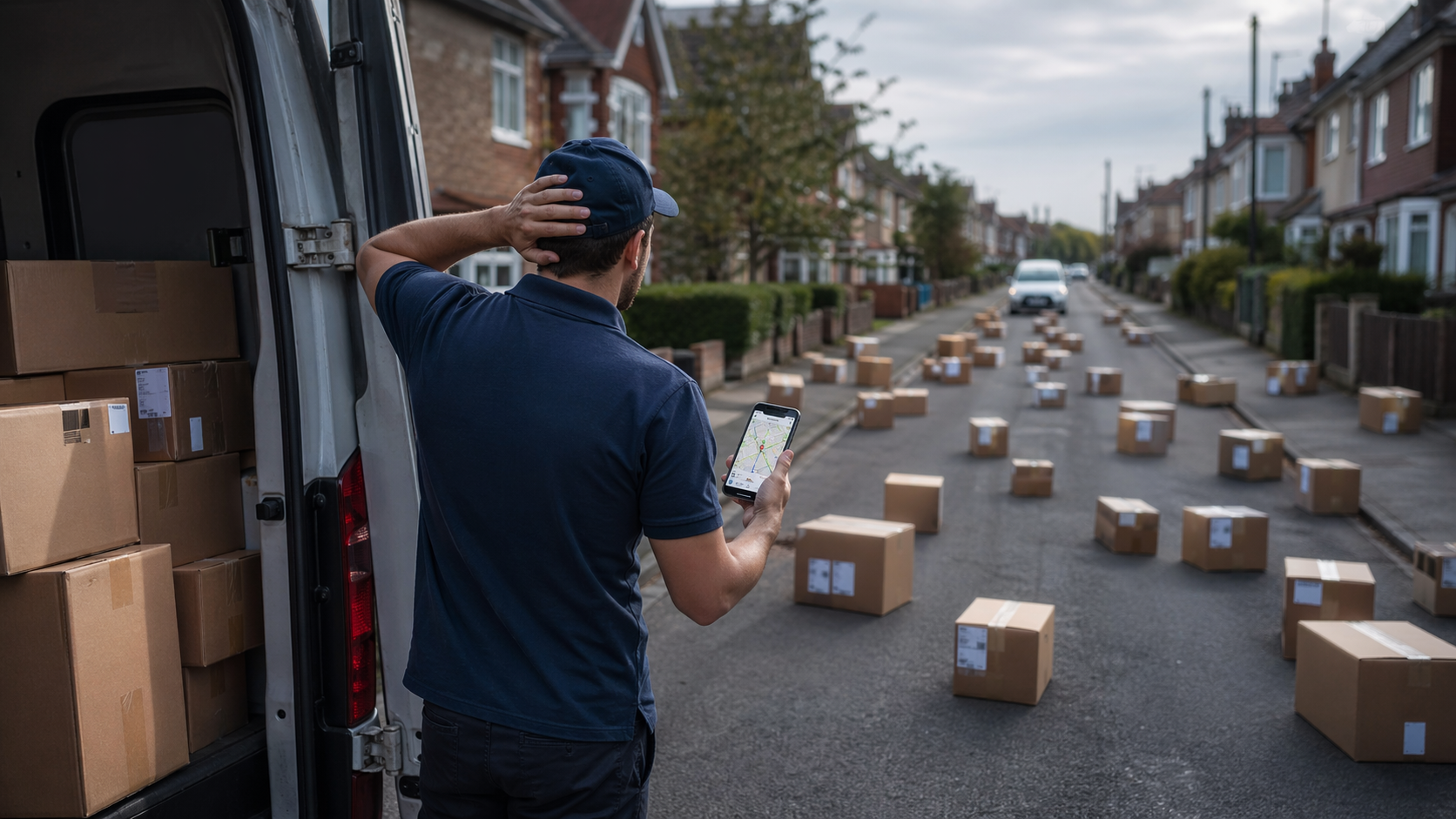
A typical delivery day rarely goes as planned. A driver starts with a route that seems efficient, but quickly faces traffic congestion, last-minute order changes, and tight delivery windows. Stops that looked logically arranged begin to feel scattered, forcing constant adjustments and unnecessary backtracking. Fuel is wasted, time slips away, and customers are left waiting.
These challenges are not random. They stem from how routes are planned in the first place. As delivery networks expand, poor planning becomes a costly and recurring issue rather than a one-off inconvenience.
Modern parcel delivery has evolved into a highly demanding operation. Routes often include dozens or even hundreds of stops, each with its own constraints. At the same time, customers expect fast and predictable service, often within same-day or next-day timeframes. Add urban congestion, road closures, and unpredictable conditions, and the complexity increases dramatically.
Where Route Planning Breaks Down
Many delivery operations still rely on manual planning methods. Dispatchers use spreadsheets or depend on driver experience to organize routes. While this approach may work on a small scale, it struggles to handle the growing number of variables involved in modern logistics.
One of the most common issues is poor stop sequencing. When stops are not arranged efficiently, drivers end up covering more distance than necessary. This leads to longer routes, higher fuel costs, and delays that could have been avoided.
Another critical gap is the lack of accurate ETAs. Without reliable arrival time estimates, both customers and dispatchers operate with limited visibility. Customers become frustrated when deliveries arrive late, while dispatchers are left reacting instead of managing proactively.
Workload imbalance is also a frequent problem. Some drivers are overloaded with dense routes, while others handle fewer stops. This inconsistency leads to fatigue, reduced productivity, and uneven service quality.
On top of that, many teams lack real-time visibility. Without clear insight into route progress, it becomes difficult to respond to delays or adjust plans during the day.
The Cost of Inefficiency Adds Up Quickly
Inefficient routes have a direct financial impact. Longer distances mean increased fuel consumption, which raises operational expenses over time. Even small inefficiencies, when repeated daily across multiple drivers, create significant cost increases.
Time loss is another major factor. Drivers spending extra hours on the road complete fewer deliveries per shift. This reduces overall capacity and forces businesses to expand fleets sooner than necessary.
Customer experience also suffers. Late deliveries and missed time windows damage trust and increase support inquiries. In competitive markets, reliability often matters more than price.
Scaling becomes more difficult as well. When inefficiencies are built into the system, growth requires more vehicles, more drivers, and more resources, rather than smarter operations.
Why Navigation Apps Fall Short
Navigation tools like Google Maps, Apple Maps, and Waze are widely used by drivers, but they are not designed for delivery logistics.
These apps focus on getting from point A to point B. They do not optimize routes with multiple stops or consider delivery-specific constraints. Drivers are left to decide the order of stops themselves, which often leads to inefficient routing.
Another limitation is the lack of full-route visibility. While these tools provide accurate navigation for individual legs, they do not offer a complete overview of the entire route with reliable ETAs for each stop.
What Efficient Routing Actually Looks Like
Effective route planning is based on automation and data rather than guesswork. Instead of manually arranging stops, optimized systems calculate the most efficient sequence using multiple variables such as distance, traffic, and delivery constraints.
Scalability is a key factor. A well-designed routing system should handle both small and large volumes of stops without losing accuracy. Whether a route includes 15 deliveries or 150, the logic remains consistent.
Accurate ETAs play a central role. When every stop has a reliable time estimate, communication improves across the board. Customers know when to expect deliveries, and dispatchers can manage operations more effectively.
Integration also matters. Drivers should be able to follow optimized routes using familiar navigation tools, ensuring a smooth transition between planning and execution.
How Delivery Teams Are Adapting
Businesses are gradually shifting away from manual planning and adopting automated solutions. This change reduces the time spent organizing routes and improves overall efficiency.
Specialized route planning tools are designed specifically for multi-stop delivery scenarios. They address key challenges such as stop sequencing, workload distribution, and ETA calculation in a way that general navigation apps cannot.
For instance, Courier Route Planner App for Parcel Delivery like Optiway allow teams to generate optimized routes within seconds, even when dealing with large volumes of stops. They can handle up to 200 deliveries in a single route while providing accurate ETAs and maintaining compatibility with navigation apps like Google Maps, Apple Maps, or Waze. This approach simplifies complex logistics without requiring drivers to change how they navigate.
Practical Ways to Improve Delivery Efficiency
Improving route efficiency does not always require a complete system overhaul. Several practical adjustments can make a noticeable difference:
- Centralize all delivery data before planning begins
- Replace manual sequencing with automated optimization
- Review route performance regularly and refine strategies
- Provide drivers with tools that simplify route execution
Ensuring that drivers have clear, easy-to-follow routes is just as important as optimizing them. Even the most efficient plan can fail if it is difficult to execute in real-world conditions.
What Lies Ahead for Delivery Routing
Routing technology continues to evolve. Algorithms are becoming more advanced, allowing routes to adjust dynamically based on real-time conditions such as traffic or new orders.
Automation is no longer a competitive advantage – it is quickly becoming a baseline requirement. As delivery volumes grow and customer expectations rise, relying on manual processes becomes increasingly unsustainable.
Speed and accuracy will define future delivery operations. Customers expect precise timing, and businesses must meet those expectations without significantly increasing costs.
Inefficient route planning remains one of the most overlooked issues in parcel delivery. It quietly affects profitability, service quality, and the ability to scale. Companies that invest in better planning methods position themselves to operate more efficiently and respond effectively to growing demand.
Related: Why Last-Mile Delivery Keeps Costing 3PLs More Than It Should