
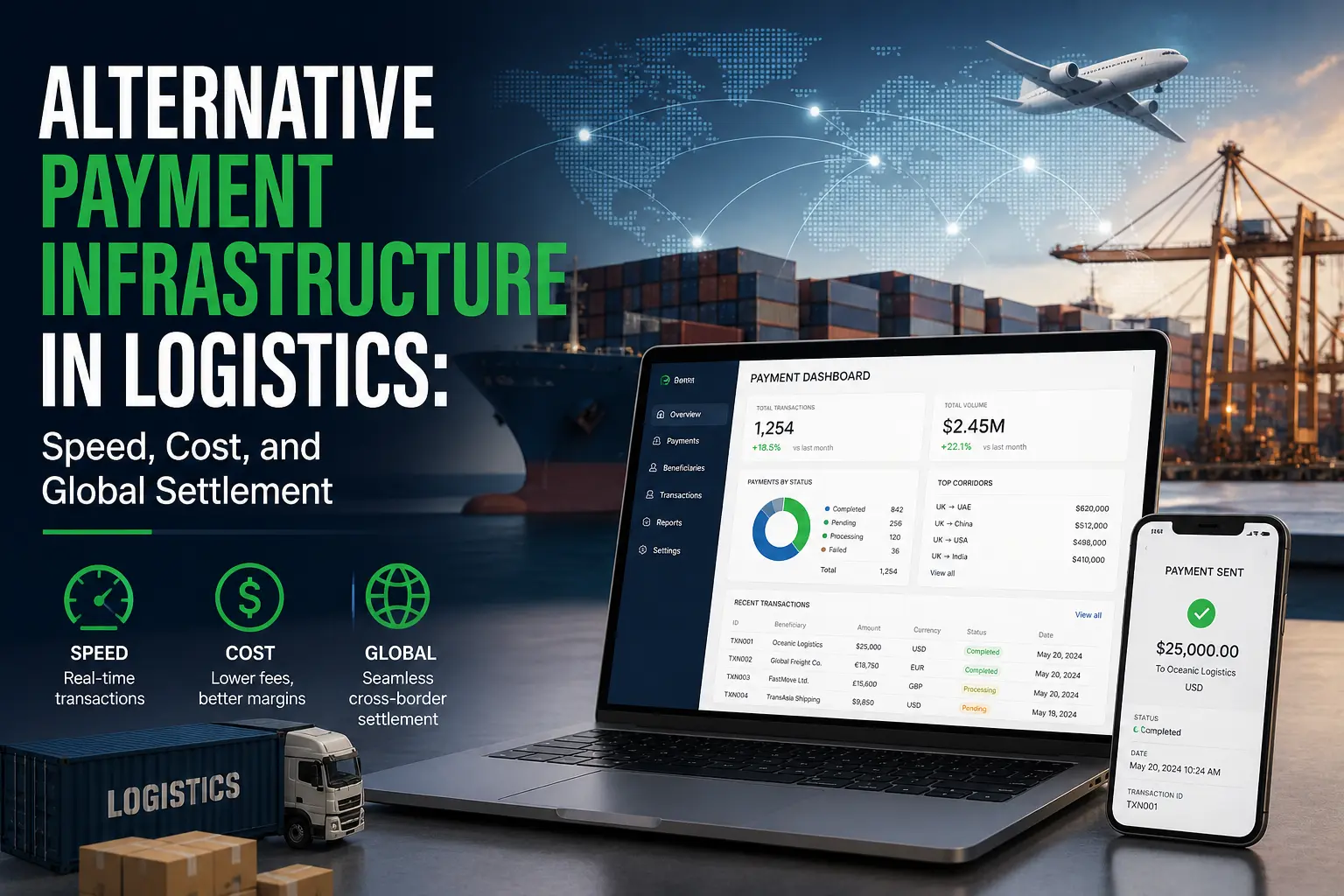
The Growing Role of Alternative Payment Infrastructure in Global Logistics
Global logistics depends not only on the physical movement of goods, but also on the timely movement of money. Payments sit at the center of every transaction between suppliers, carriers, intermediaries, and end buyers. When settlement is delayed or inefficient, the impact extends beyond finance, affecting delivery timelines, working capital, and operational planning.
In recent years, pressure has been building on traditional payment systems. As supply chains become more global and time-sensitive, the limitations of existing cross-border infrastructure are becoming more visible. This has led to growing interest in alternative payment models designed to reduce friction, accelerate settlement, and improve the flow of value across international networks.
Payment Friction as a Structural Challenge in Global Logistics
Payment friction remains a persistent constraint in global logistics operations. Cross-border transactions often pass through multiple financial institutions, each adding processing time, compliance checks, and cost layers. While these systems are well established, they were not designed for the speed and flexibility required by modern supply chains.
Delays in settlement can create operational bottlenecks. A shipment may be ready to move, but financial confirmation is still pending. Funds may be in transit between banks, subject to clearing times that vary by jurisdiction and institution. These gaps introduce uncertainty into processes that increasingly rely on precision and timing.
The structure of international payments also contributes to cost inefficiencies. Transaction fees, foreign exchange spreads, and intermediary charges accumulate across the payment chain, particularly in complex trade routes. For logistics operators working with tight margins, these costs are not incidental – they directly affect profitability and competitiveness.
As a result, payment infrastructure is no longer a background function. It is an operational variable that influences how quickly and efficiently goods can move through global supply networks.
Why Traditional Payment Systems Struggle at Scale
Traditional cross-border payment systems were built for stability and control, not for speed across highly fragmented global networks. As logistics operations expand across jurisdictions, currencies, and counterparties, these systems begin to show structural limitations. Each transaction must pass through established financial channels, often involving correspondent banks, clearing systems, and layered verification processes.
This architecture introduces latency that is difficult to eliminate. Even when all parties are aligned, settlement is rarely instantaneous. Time zone differences, batch processing cycles, and compliance procedures all contribute to delays that can extend beyond operational expectations. In a supply chain environment where timing directly affects cost and reliability, these delays become a material constraint rather than a minor inconvenience.
Settlement Delays and Operational Bottlenecks
Settlement delays are not only a financial issue – they directly affect logistics execution. When payments are not confirmed in time, shipments may be held, services delayed, or contractual obligations paused. This creates a disconnect between physical readiness and financial clearance.
In practice, this means that even efficient logistics operations remain partially dependent on the speed of external financial systems. A delay in settlement can cascade through the supply chain, affecting scheduling, inventory planning, and coordination between multiple stakeholders.
Cost Layers in Cross-Border Transactions
Alongside delays, cost accumulation presents another challenge. Cross-border payments typically involve multiple intermediaries, each applying fees for processing, currency conversion, and risk management. These costs are often embedded within the transaction flow, making them less visible but no less significant.
Foreign exchange spreads further increase the financial burden, particularly in routes involving less liquid currency pairs. For logistics operators managing frequent international transactions, these incremental costs can scale quickly. Over time, they become a structural expense that reduces efficiency and limits flexibility in pricing and operations.
The Emergence of Alternative Payment Infrastructure
As the limitations of traditional systems become more apparent, alternative payment infrastructure has begun to attract attention. These models aim to reduce reliance on multi-layered banking networks by enabling more direct transfer of value between parties. The focus is not on replacing existing systems entirely, but on addressing specific inefficiencies – particularly speed, cost, and transparency in cross-border settlement.
Digital payment networks, including those built on blockchain-based systems, introduce a different operational model. Transactions can be processed continuously rather than in batches, and settlement can occur without passing through multiple intermediary institutions. This reduces both the time required to complete a transfer and the number of points at which delays or additional costs can be introduced.
At the same time, these systems are evolving within a broader financial landscape that remains heavily regulated and institutionally driven. As a result, their adoption is uneven and often context-dependent. In logistics, where reliability and compliance are critical, the role of alternative infrastructure is likely to develop gradually, complementing rather than immediately replacing existing payment frameworks.
Stablecoins and Faster Settlement Models
One of the more practical developments within alternative payment infrastructure is the use of stablecoins for cross-border settlement. Unlike traditional cryptocurrencies, which are often subject to price volatility, stablecoins are designed to maintain a consistent value relative to a reference asset, typically a major fiat currency. This makes them more suitable for operational use cases where predictability is essential.
For logistics operations, the primary advantage lies in settlement speed. Transactions can be executed and confirmed in significantly shorter timeframes compared to traditional banking channels. This reduces the gap between financial confirmation and physical movement, allowing processes to align more closely. Faster settlement can improve coordination between parties, particularly in time-sensitive segments of the supply chain.
Near-Instant Transfers and Predictable Value
Stablecoin-based transactions are not bound by the same clearing cycles as conventional payment systems. They can be processed continuously, without waiting for batch windows or banking hours. This enables near real-time transfer of value across jurisdictions, which is particularly relevant in logistics environments that operate on tight schedules.
Equally important is value stability. By minimizing exposure to price fluctuations, stablecoins allow businesses to transact without introducing additional financial risk. This combination of speed and predictability makes them a functional tool rather than a speculative asset in operational contexts.
Reduced Dependence on Intermediaries
Stablecoin transactions can also reduce the number of intermediaries involved in settlement. Instead of passing through multiple banks and clearing systems, value can be transferred directly between counterparties using a shared network. This simplifies the payment chain and can lower associated costs.
However, this does not eliminate the need for oversight or integration with existing systems. Businesses must still consider compliance requirements, custody arrangements, and internal controls. The reduction in intermediaries changes the structure of the process, but it does not remove the need for governance.
Understanding Token Standards in Payment Networks
As digital payment systems develop, differences between underlying networks and token standards become operationally relevant. Not all transactions are processed in the same way, and the design of a given network can influence speed, cost, and compatibility with different use cases. For logistics operators evaluating alternative payment methods, these distinctions are not purely technical – they affect reliability and efficiency.
Different token standards define how assets are issued, transferred, and managed within a given network. These standards determine transaction formats, processing requirements, and interaction with supporting infrastructure. As a result, they play a role in shaping how easily a payment system can be integrated into existing operational workflows.
Network Design and Transaction Efficiency
Network architecture has a direct impact on transaction performance. Some systems prioritize throughput and low transaction costs, while others emphasize security, decentralization, or interoperability. The choice of network affects how quickly payments can be processed and how predictable transaction costs will be over time.
For logistics applications, consistency is often as important as speed. Payment systems must function reliably across different conditions, without introducing variability that could disrupt planning or coordination. Understanding how network design influences these factors is therefore essential when assessing alternative infrastructure.
Practical Example of Token Standards in Use
In practical terms, widely used stablecoins can operate across multiple networks, each with its own token standard. This creates variation in how transactions are executed, even when the underlying asset remains the same. For example, when evaluating how a specific transfer method works, it is common to encounter questions such as what is trc20, which refers to a token standard used on a particular network for issuing and transferring digital assets.
From an operational perspective, the relevance of such standards lies in their impact on transaction behavior. Differences in processing speed, fee structure, and network capacity can influence which option is more suitable in a given context. For logistics operators, this is less about technical detail and more about selecting infrastructure that aligns with performance and cost requirements.
Implications for Logistics Operations
Changes in payment infrastructure have direct operational consequences for logistics businesses. Faster settlement can reduce delays between contractual agreement and execution, allowing shipments to move without waiting for extended financial confirmation. This is particularly relevant in time-sensitive supply chains, where even small delays can disrupt scheduling and coordination across multiple parties.
Improved payment efficiency also affects working capital management. When funds are transferred more quickly, businesses can reduce the amount of capital tied up in transit. This creates more flexibility in managing cash flow, especially in environments with frequent cross-border transactions. Over time, even incremental improvements in settlement speed can translate into measurable gains in liquidity and operational efficiency.
At the same time, the adoption of alternative payment systems introduces new considerations. Integration with existing enterprise systems, alignment with accounting practices, and coordination with financial partners all require careful planning. Payment infrastructure cannot be evaluated in isolation – it must fit within the broader operational framework of the organization.
Balancing Innovation with Regulation and Risk
While alternative payment models offer clear advantages in speed and cost, their use in logistics is shaped by regulatory and risk considerations. Cross-border transactions are subject to a range of compliance requirements, including anti-money laundering controls, reporting obligations, and jurisdiction-specific regulations. Any new payment method must operate within this framework.
Regulatory clarity remains uneven across regions. Some jurisdictions have established guidelines for the use of digital assets in commercial transactions, while others maintain restrictive or evolving positions. This creates uncertainty for logistics operators working across multiple markets, where a payment method acceptable in one region may present challenges in another.
Risk management is also a central factor. Beyond regulatory compliance, businesses must consider custody arrangements, counterparty risk, and operational security. The shift from traditional banking systems to alternative infrastructure changes how these risks are distributed and managed. As a result, adoption tends to be gradual, with organizations testing new models in specific contexts before expanding their use.
These constraints do not prevent the use of alternative payment infrastructure, but they shape its role. In practice, the most likely outcome is a hybrid model, where new systems are integrated alongside established financial channels, balancing efficiency gains with regulatory and operational requirements.
The Future of Payment Infrastructure in Logistics
The evolution of payment infrastructure in logistics is unlikely to follow a single path. Traditional banking systems remain deeply embedded in global trade, supported by regulatory frameworks, institutional trust, and established processes. At the same time, alternative payment models are addressing specific inefficiencies that have become more visible as supply chains grow in scale and complexity.
Rather than a replacement dynamic, the trajectory points toward coexistence. Logistics operators are likely to adopt new payment mechanisms selectively, applying them in contexts where speed, cost, or accessibility provide a clear advantage. In parallel, conventional systems will continue to serve functions where regulatory certainty and institutional integration are critical.
This layered approach reflects the broader nature of the logistics industry. It operates across jurisdictions, regulatory environments, and technological standards, requiring flexibility rather than uniformity. Payment infrastructure is becoming part of that adaptive framework, evolving in response to operational demands rather than being reshaped all at once.
Over time, the distinction between traditional and alternative systems may become less pronounced. As technologies mature and regulatory clarity improves, elements of both models are likely to converge. For logistics businesses, the key consideration will not be which system replaces another, but how different forms of infrastructure can be combined to support efficient, reliable global operations.
Related: The Hidden Costs of Compliance: How Logistics Companies Can Avoid Falling into IRS Debt
Related: Navigating Global Trade: The Role of Smart Logistics in a Data-Driven World