

Table of Contents
The UK HGV Driver Shortage remains one of the most significant operational challenges for the logistics industry in 2026. Road freight moves nearly 89% of all domestic goods in the United Kingdom, making heavy goods vehicle drivers essential to supply chain stability. When driver availability drops, delivery schedules slip, costs rise, and retail supply chains face disruption.
The issue intensified after Brexit, COVID-19 disruptions, and an ageing driver workforce reduced the number of qualified drivers. The shortage peaked at over 100,000 drivers in 2021. Training initiatives and licensing reforms helped narrow the gap, yet the sector still faces a structural shortage estimated between 40,000 and 60,000 drivers in 2025–2026.
Logistics companies continue adapting operations to manage this pressure. They are raising wages, investing in driver recruitment programmes, and deploying technology to optimise fleets.
Understanding the Scale of the UK HGV Driver Shortage

The UK HGV Driver Shortage has evolved from a temporary disruption into a structural workforce challenge. The shortage developed gradually over more than a decade.
Current Driver Workforce Data
Recent industry reports show the UK relies on a workforce of approximately 300,000 licensed HGV drivers. However, only around 260,000–270,000 are actively working in the sector. Many licence holders move to other industries due to working conditions.
Key figures illustrate the ongoing gap:
- Peak shortage in 2021: 100,000 drivers
- Estimated shortage in 2025–2026: 40,000–60,000 drivers
- Average driver age: 51 years
- Drivers under 25: less than 2% of the workforce
This age imbalance signals long-term workforce pressure. Many drivers are expected to retire within the next decade, intensifying recruitment needs.
Government Response and Training Initiatives
The UK government introduced several programmes to reduce the UK HGV Driver Shortage. Measures focused on accelerating training and testing capacity.
Major initiatives include:
- Short-term visa schemes allowing foreign drivers to work temporarily.
- Increased HGV driving tests to reduce licensing delays.
- Skills bootcamps to train thousands of new drivers.
- Funding for driver training programmes through industry partnerships.
Government topical events on the HGV driver shortage, testing capacity increased significantly between 2022 and 2024. This helped add thousands of newly qualified drivers.
Key Causes Behind the UK HGV Driver Shortage

The UK HGV Driver Shortage developed due to several overlapping structural factors. Understanding these causes helps logistics firms develop practical solutions.
Ageing Workforce
The logistics workforce is ageing rapidly. The average driver age of 51 years indicates a large retirement wave approaching.
Younger workers often avoid the profession due to long hours and extended periods away from home. Industry surveys show less than 3% of drivers are under 25.
Brexit and Reduced EU Labour Supply
Before Brexit, many HGV drivers working in the UK came from EU countries. New immigration rules significantly reduced this labour pool.
Industry estimates suggest over 20,000 EU drivers left the UK logistics sector between 2019 and 2022. Temporary visa programmes replaced only a small portion of that workforce.
Working Conditions and Industry Perception
Working conditions remain another major cause of the UK HGV Driver Shortage. Drivers frequently cite several concerns.
Impact of the UK HGV Driver Shortage on Logistics Companies

The UK HGV Driver Shortage directly affects operational efficiency and supply chain stability. Logistics firms face rising costs and delivery constraints.
Rising Labour and Transport Costs
Driver wages increased significantly due to supply shortages. Average HGV driver salaries rose from roughly £32,500 in 2020 to around £44,000 in 2025.
Higher wages help attract drivers but increase operating costs for logistics companies.
Additional expenses include:
- Recruitment campaigns
- Training programmes
- Overtime payments
- Agency driver costs
Supply Chain Delays and Capacity Limits
Driver shortages reduce available fleet capacity. Trucks remain parked when companies cannot recruit qualified drivers.
Consequences include:
- Delayed retail deliveries
- Slower warehouse replenishment
- Higher inventory buffers
- Increased logistics planning complexity
Logistics Performance Metrics
The following table shows how the shortage affects key logistics performance indicators.
| Logistics Metric | Before Shortage (2019) | During Shortage (2025) |
|---|---|---|
| Average driver salary | £32,500 | £44,000 |
| Vacant driver positions | 25,000 | 40,000–60,000 |
| Average delivery delays | 6% | 11% |
| Recruitment cost per driver | £2,000 | £4,500 |
Practical Solutions for Logistics Companies
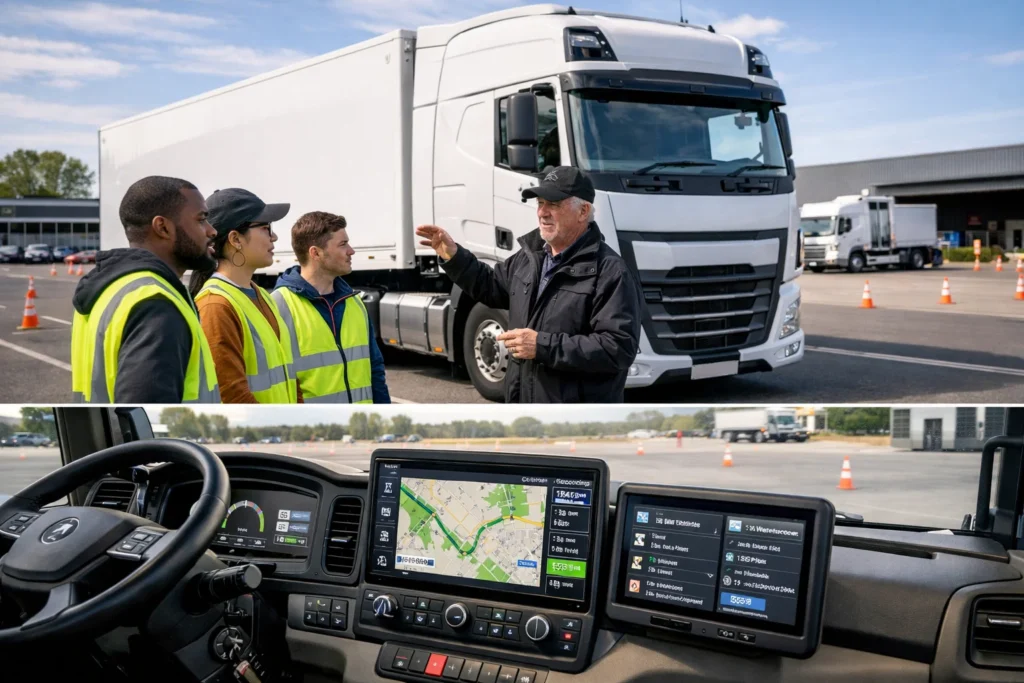
Solving the UK HGV Driver Shortage requires a combination of recruitment strategies, technology adoption, and improved working conditions.
Driver Recruitment and Training Programmes
Many logistics companies now operate internal training academies. These programmes help convert warehouse workers or apprentices into licensed drivers.
Effective recruitment strategies include:
- Apprenticeships for young drivers.
- Sponsored licence training programmes.
- Partnerships with driving schools.
- Targeted recruitment of underrepresented groups.
Improving Driver Retention
Retention strategies are equally important. Logistics companies must improve the driver experience.
Successful retention initiatives include:
- Predictable schedules
- Modern truck fleets
- Improved rest facilities
- Performance bonuses
Technology and Fleet Optimisation
Technology also reduces pressure caused by the UK HGV Driver Shortage. Modern fleet systems improve efficiency.
Key tools include:
- Route optimisation software
- Transport management systems (TMS)
- Telematics monitoring
- AI-based scheduling
Long-Term Outlook for the UK HGV Driver Workforce

The UK HGV Driver Shortage will likely remain a long-term industry challenge. Demographic trends indicate workforce pressure continuing through the 2030s.
Several factors will shape the future labour market.
Recruitment of Younger Drivers
Industry organisations now promote driving careers through school outreach and apprenticeships. Attracting younger workers is critical.
Lowering the minimum age for some HGV licences to 18 years supports earlier entry into the profession.
Automation and Emerging Transport Technology
Automation may eventually reduce labour demand. However, fully autonomous freight vehicles remain years away from large-scale adoption.
For the foreseeable future, logistics companies will rely heavily on human drivers.
Infrastructure and Policy Support
Government support remains important. Investment in driver rest areas and training programmes improves recruitment outcomes.
Industry cooperation between regulators, logistics firms, and training providers will determine how effectively the sector addresses the UK HGV Driver Shortage.
Bottom Line
The UK HGV Driver Shortage remains a critical issue shaping the logistics industry in 2026. Although government programmes and industry initiatives reduced the crisis from its 2021 peak, thousands of driver vacancies remain across the sector.
Logistics companies must take proactive action to manage the shortage. Recruitment pipelines, improved working conditions, and modern fleet technology all contribute to a more resilient workforce strategy.