

Table of Contents
Warehouse Management Systems are transforming how UK companies control inventory, process orders, and manage warehouse operations. In 2026, UK logistics firms face rising e-commerce demand, labour shortages, and stricter delivery expectations. These pressures push businesses to adopt smarter warehouse technology that improves accuracy and speeds up fulfilment.
A Warehouse Management System (WMS) is specialised software that manages inventory movement inside warehouses. It tracks goods from receiving to storage, picking, packing, and shipping. Modern WMS platforms integrate automation, barcode scanning, and real-time data analytics to improve operational efficiency. Companies using WMS often reduce inventory errors by more than 30% and improve picking accuracy to 99.9%.
The UK warehousing sector continues to expand. The Office for National Statistics reported UK warehousing and storage output reached £17.4 billion in 2025, driven by e-commerce growth. Businesses now prioritise digital infrastructure to handle higher order volumes and complex supply chains.
What Are Warehouse Management Systems?

Warehouse Management Systems are digital platforms that control and optimise warehouse operations. They manage inventory locations, track product movement, and guide warehouse staff through efficient workflows.
Modern WMS platforms connect multiple warehouse functions through a central database. This ensures accurate inventory data across procurement, logistics, and distribution teams. Systems often integrate with Enterprise Resource Planning (ERP) and Transportation Management Systems (TMS) to create a unified supply chain network.
According to SAP’s supply chain research published in 2026, companies implementing advanced Warehouse Management Systems reduce warehouse operating costs by 15–25% within two years.
Core Functions of a Warehouse Management System
A modern WMS typically performs the following operational tasks:
- Inventory tracking and location management
- Goods receiving and putaway optimisation
- Order picking and packing coordination
- Barcode and RFID scanning integration
- Labour productivity monitoring
- Real-time stock visibility
These capabilities allow warehouse managers to maintain full control over inventory movement. Accurate data reduces stock discrepancies and improves fulfilment reliability.
Key Components of WMS Platforms
| Component | Function | Operational Benefit |
|---|---|---|
| Inventory Control | Tracks stock levels and locations | Reduces stock discrepancies |
| Picking Management | Guides pickers through optimised routes | Improves picking speed |
| Warehouse Mapping | Maps storage zones and rack locations | Maximises space utilisation |
| Order Processing | Automates picking and packing workflows | Accelerates fulfilment |
| Reporting Analytics | Provides operational insights | Improves decision-making |
How WMS Improves Inventory Accuracy
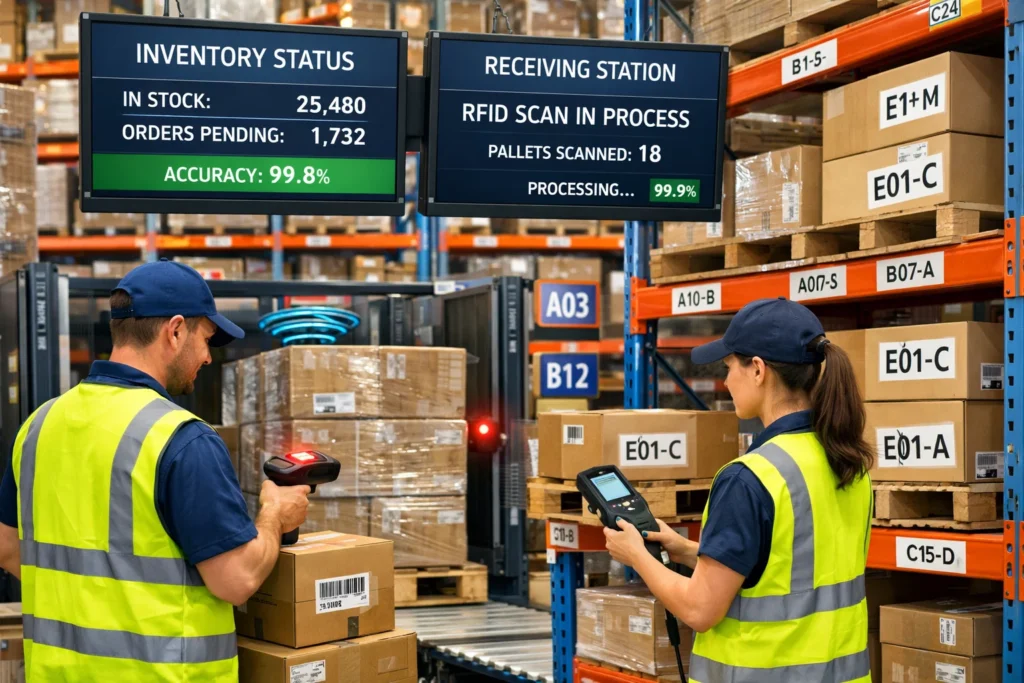
Inventory accuracy remains one of the biggest challenges in warehouse operations. Manual inventory processes often produce counting errors, misplaced stock, and delayed updates.
Warehouse Management Systems eliminate many of these issues through real-time tracking and automated data capture.
Barcode scanners and RFID technology instantly update inventory records when products move through the warehouse. This prevents discrepancies between physical stock and digital records.
Real-Time Inventory Visibility
Real-time visibility allows managers to monitor stock movement continuously. This improves inventory planning and prevents stockouts.
Key benefits include:
- Accurate stock counts across multiple warehouse locations
- Faster inventory reconciliation
- Better demand forecasting
- Reduced excess inventory
These advantages allow businesses to optimise inventory levels and improve working capital efficiency.
Automated Putaway and Slotting
WMS software also optimises where products are stored within the warehouse.
Automated slotting algorithms analyse product demand, size, and picking frequency. The system then assigns optimal storage locations to minimise travel time.
High-velocity products move closer to picking zones, while slower items remain in secondary storage. This reduces picking distances and increases worker productivity.
WMS and Faster Order Fulfilment
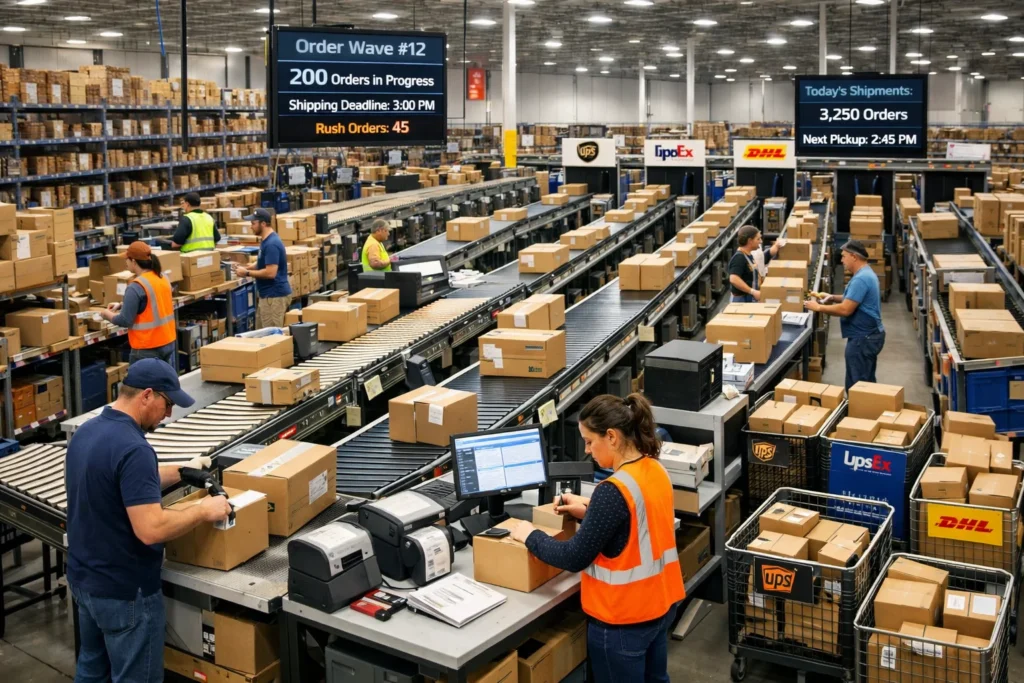
Order fulfilment speed is critical for UK retailers and logistics providers. Consumers now expect next-day or even same-day delivery.
Warehouse Management Systems streamline fulfilment workflows through automation and optimised picking processes.
Optimised Picking Strategies
WMS platforms support multiple picking methods depending on order volume and warehouse layout.
Common strategies include:
- Batch picking – multiple orders picked simultaneously
- Zone picking – pickers assigned to specific warehouse zones
- Wave picking – orders grouped by shipping schedule
These strategies reduce warehouse congestion and improve order processing speed.
Packing and Shipping Automation
Once items are picked, WMS software coordinates packing operations and shipment preparation.
Key automation features include:
- Automatic shipping label generation
- Packaging optimisation based on order size
- Carrier selection integration
- Real-time dispatch tracking
Benefits of Warehouse Management Systems for UK Companies
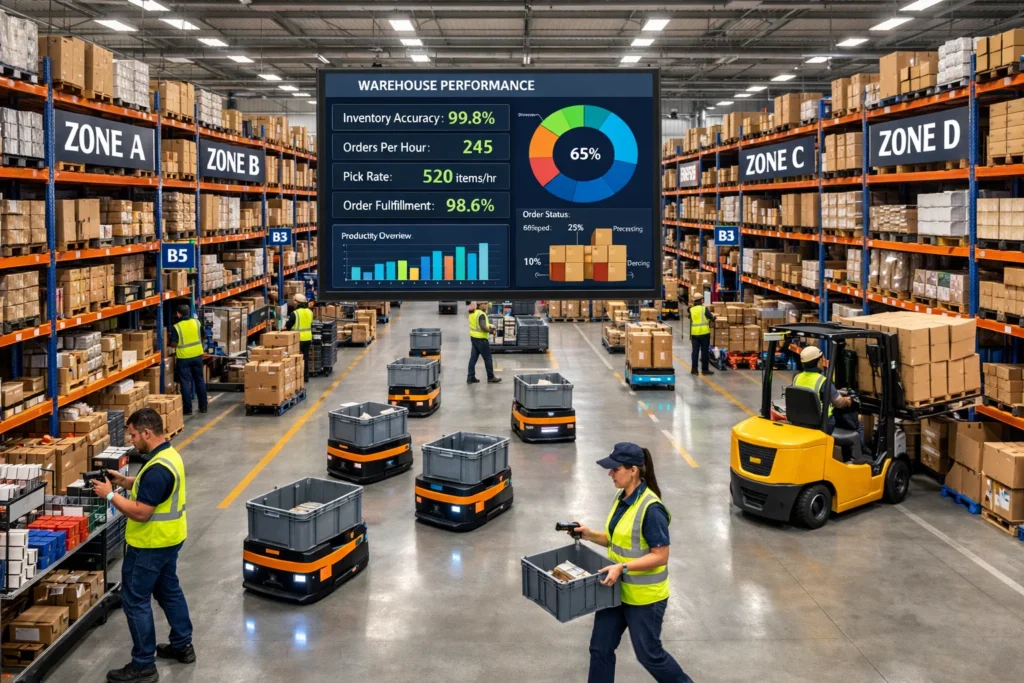
Warehouse Management Systems provide measurable operational improvements across the entire logistics network.
Key benefits include:
- Improved inventory accuracy: Real-time tracking prevents stock discrepancies.
- Faster order processing: Automated workflows accelerate fulfilment.
- Better labour productivity: Optimised picking routes reduce travel time.
- Higher warehouse capacity: Intelligent slotting improves space utilisation.
- Enhanced customer satisfaction: Accurate and fast deliveries improve service reliability.
Many UK retailers and third-party logistics providers now depend on WMS technology to manage growing order volumes.
Typical Performance Improvements
| Operational Metric | Before WMS | After WMS |
|---|---|---|
| Inventory accuracy | 92–95% | 99%+ |
| Order picking speed | Baseline | +30% |
| Warehouse labour productivity | Baseline | +20% |
| Order fulfilment time | 24–48 hours | 12–24 hours |
Challenges When Implementing WMS

Although Warehouse Management Systems deliver major benefits, implementation requires careful planning.
Integration with Existing Systems
Many companies already operate ERP and inventory software. Integrating these systems with a new WMS requires technical expertise.
Poor integration can create data inconsistencies or workflow disruptions.
Workforce Training
Warehouse employees must learn new workflows and scanning technologies.
Training programmes typically require 3–6 weeks to ensure staff fully understand system operations.
Implementation Costs
WMS implementation costs vary depending on warehouse size and system complexity.
Typical costs in the UK include:
- Small warehouse: £40,000–£80,000
- Medium warehouse: £120,000–£350,000
- Large automated distribution centre: £500,000+
Despite these costs, most companies achieve return on investment within 18–24 months due to efficiency improvements.
Bottom Line
Warehouse Management Systems have become essential technology for UK logistics and distribution operations. Rising e-commerce demand requires faster fulfilment, accurate inventory control, and efficient warehouse workflows.
Modern WMS platforms deliver these capabilities through automation, real-time tracking, and intelligent inventory management. Companies implementing these systems often achieve significant improvements in picking accuracy, order processing speed, and warehouse productivity.