
Table of Contents
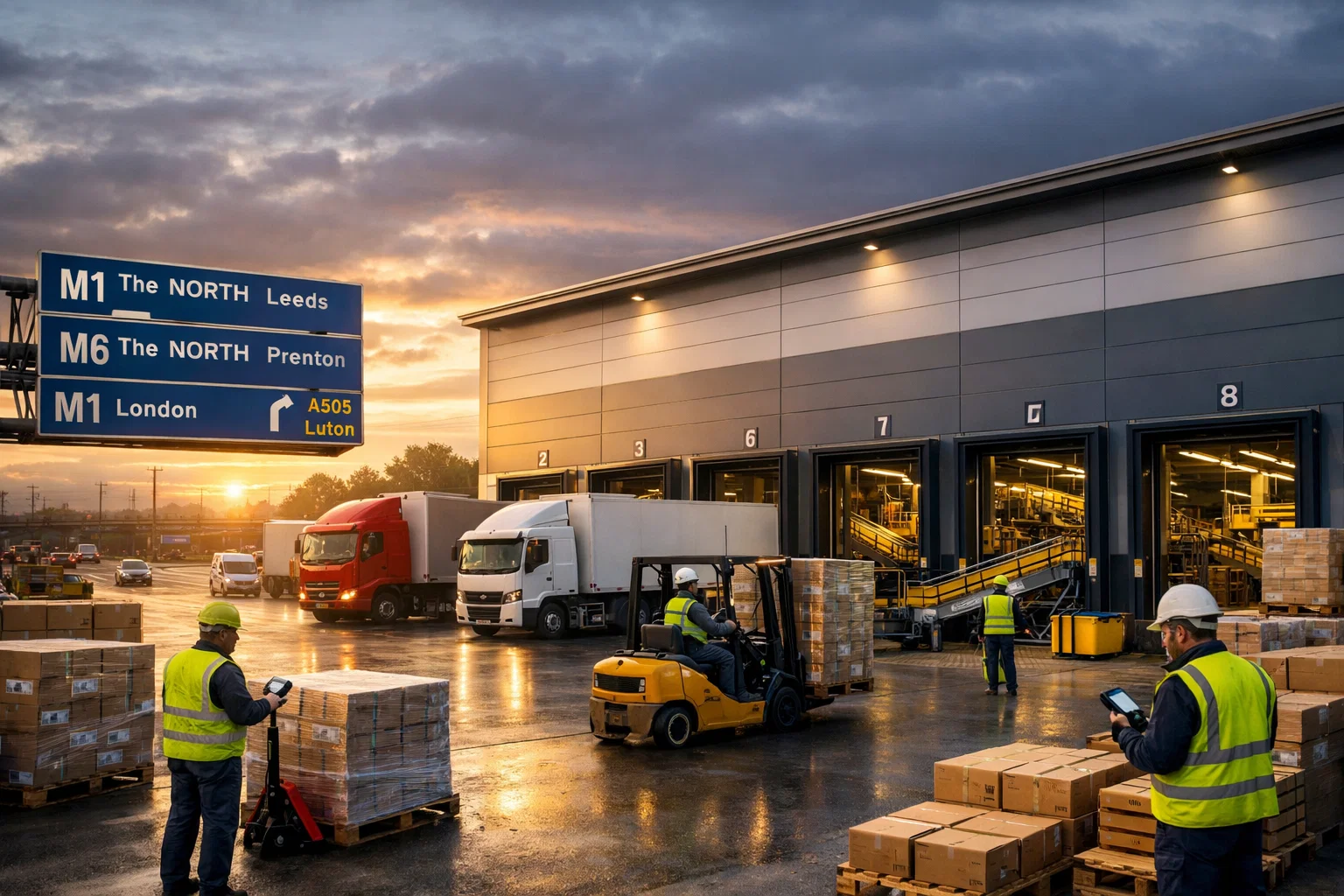
UK Warehousing and Distribution has become a strategic backbone for modern supply chains. As of 2026, the UK logistics sector contributes over £185 billion annually to the economy, supporting more than 2.7 million jobs across storage, transport, and fulfilment operations. The growth of e-commerce, same-day delivery expectations, and global supply disruptions has transformed warehouses from simple storage spaces into highly integrated logistics hubs.
Businesses operating in the UK now rely on sophisticated warehouse management systems (WMS), automation technologies, and multi-channel distribution networks to meet customer demand. According to the UK Warehousing Association, warehouse floor space across the country exceeded 670 million square feet in 2025, reflecting rapid expansion driven by online retail and international trade.
Modern supply chains demand speed, accuracy, and scalability. Companies must coordinate inventory storage, order fulfillment, and final-mile delivery efficiently. Effective UK Warehousing and Distribution strategies help businesses reduce operational costs, improve order accuracy, and accelerate delivery times.
This guide explains how UK warehousing works, what technologies shape distribution networks, and how companies optimise logistics operations. Understanding these systems allows businesses to build resilient supply chains that support growth and customer satisfaction.
The Role of UK Warehousing and Distribution in Supply Chains
Core Functions of Modern Warehousing
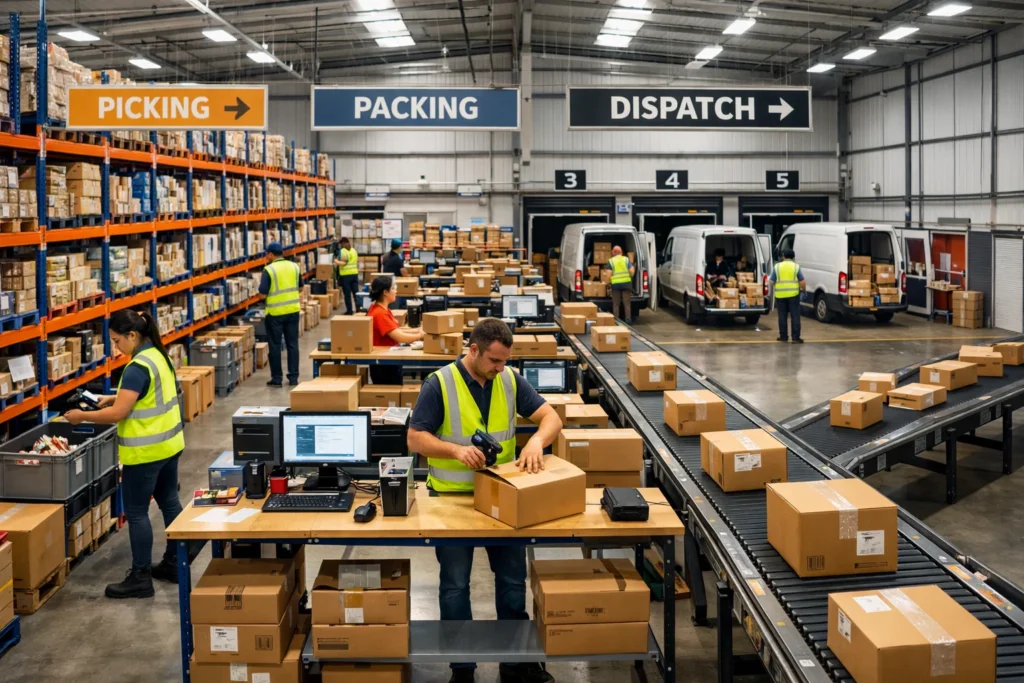
Modern UK Warehousing and Distribution operations support multiple supply chain stages. Warehouses now operate as central nodes that manage inventory flow, product handling, and order processing.
Key warehouse functions include:
- Inventory storage and stock management
- Order picking and packing
- Cross-docking for rapid distribution
- Returns processing and reverse logistics
- Retail and e-commerce fulfilment
These activities help businesses maintain product availability while controlling operational costs.
Impact on Delivery Speed and Efficiency
Speed has become the defining metric in logistics performance. UK consumers increasingly expect next-day or same-day delivery, especially for e-commerce orders.
Strategically located warehouses near transport corridors allow faster distribution to major cities such as London, Birmingham, and Manchester. According to the Office for National Statistics, online retail sales accounted for 27.3% of total UK retail sales in 2025.
Warehouse Infrastructure and Logistics Networks in the UK
Strategic Warehouse Locations
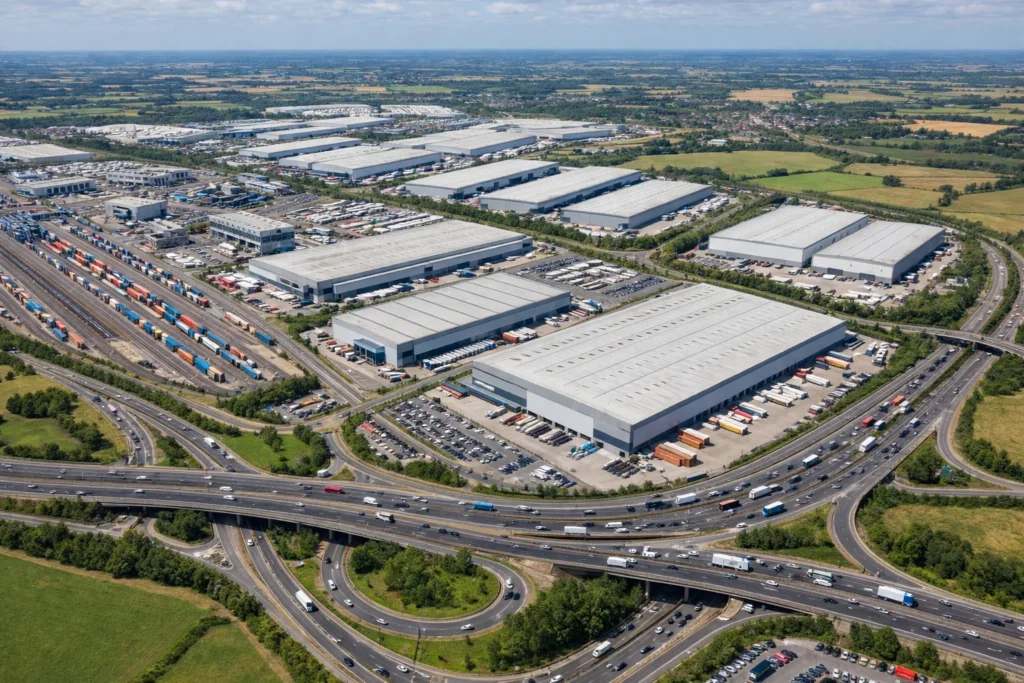
Location planning remains critical for UK Warehousing and Distribution efficiency. Most large distribution centres operate near major motorways, ports, and airports.
Common logistics hubs include:
- Midlands “Golden Triangle” (M1, M6, M42 corridor)
- Port-connected warehouses near Felixstowe and Southampton
- Urban fulfilment centres near London and Manchester
These hubs reduce transport time and enable rapid nationwide coverage.
Warehouse Size and Capacity Trends
The UK warehouse market has shifted toward larger facilities. In 2025, the average new distribution centre exceeded 300,000 square feet, with some mega-facilities surpassing 1 million square feet.
Large warehouses support:
- automated picking systems
- robotics integration
- multi-client storage operations
- high-volume e-commerce fulfilment
These facilities help companies handle increasing order volumes efficiently.
UK Warehouse Infrastructure Overview
| Warehouse Type | Average Size | Key Purpose |
|---|---|---|
| Regional Distribution Centre | 300,000–800,000 sq ft | Nationwide product distribution |
| E-commerce Fulfilment Centre | 150,000–500,000 sq ft | Online order processing |
| Urban Micro-Fulfilment Hub | 10,000–50,000 sq ft | Same-day city delivery |
| Port-side Warehouse | 100,000–400,000 sq ft | Import and export storage |
Technology Transforming UK Warehousing and Distribution
Warehouse Management Systems (WMS)
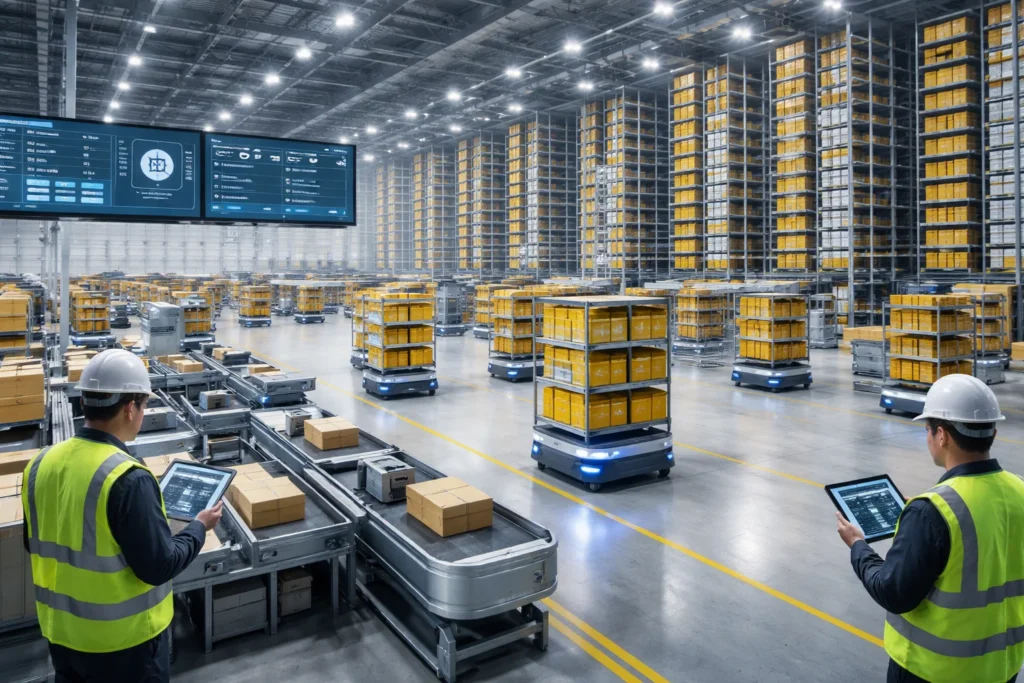
Digital systems now manage almost every warehouse process. A Warehouse Management System (WMS) tracks inventory in real time and coordinates picking, packing, and shipping operations.
Benefits of WMS technology include:
- real-time stock visibility
- improved order accuracy
- automated inventory tracking
- faster fulfilment workflows
These systems reduce manual errors and improve operational control.
Automation and Robotics
Automation is rapidly reshaping UK Warehousing and Distribution. Robotics now handle repetitive tasks such as pallet movement, item picking, and sorting.
Common warehouse automation technologies include:
- automated storage and retrieval systems (ASRS)
- robotic picking arms
- conveyor sorting systems
- autonomous mobile robots (AMRs)
According to logistics industry reports, automated warehouses can increase picking productivity by up to 300% compared with manual systems.
Data-Driven Logistics Decisions
Data analytics now guide supply chain decisions. Businesses use logistics data to forecast demand, optimise inventory placement, and reduce transport costs.
Distribution Strategies for E-commerce and Retail
Multi-Channel Fulfilment
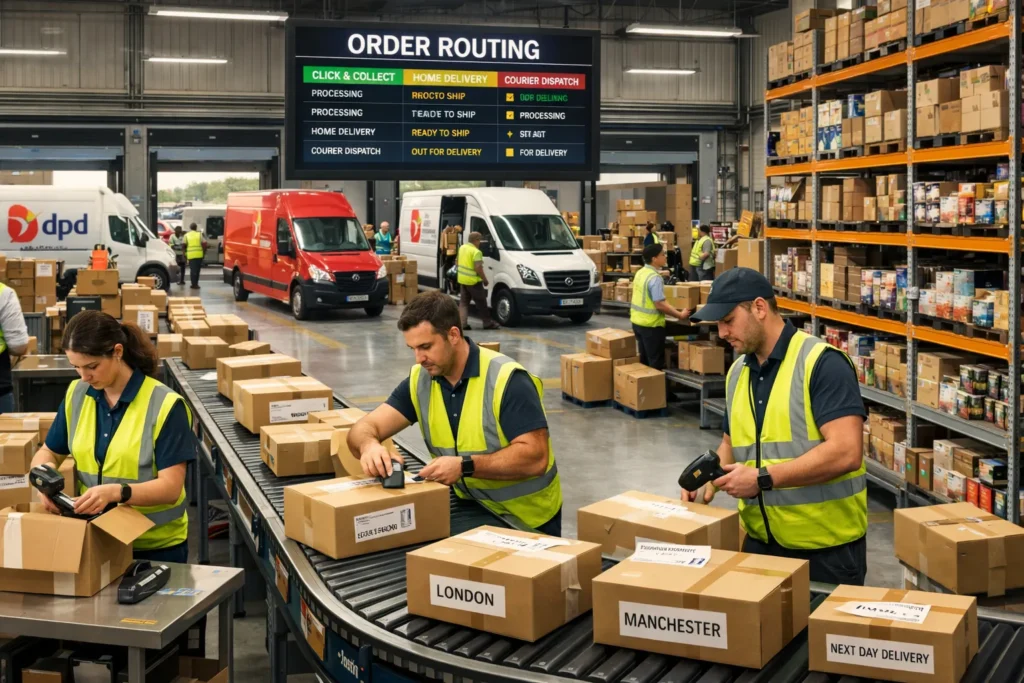
Modern UK Warehousing and Distribution systems must support both retail stores and online orders. Multi-channel fulfilment enables businesses to process orders from several sales channels simultaneously.
Common fulfilment methods include:
- Direct-to-consumer shipping
- Retail store replenishment
- Click-and-collect fulfilment
- Marketplace order integration
These models allow businesses to serve customers across multiple platforms.
Last-Mile Delivery Optimisation
Last-mile delivery represents the most expensive stage of logistics operations. In the UK, last-mile transport can account for up to 53% of total delivery costs.
Companies optimise last-mile distribution through:
- urban fulfilment centres
- route optimisation software
- local courier partnerships
- electric delivery fleets
These strategies help reduce costs while improving delivery speed.
Distribution Performance Metrics
| Metric | Typical UK Benchmark |
|---|---|
| Order accuracy | 99.5% |
| Average order processing time | 2–6 hours |
| Same-day dispatch rate | 95% |
| Warehouse picking accuracy | 99.8% |
Tracking these metrics helps logistics managers maintain operational efficiency.
Challenges in UK Warehousing and Distribution
Labour Shortages and Skills Gaps
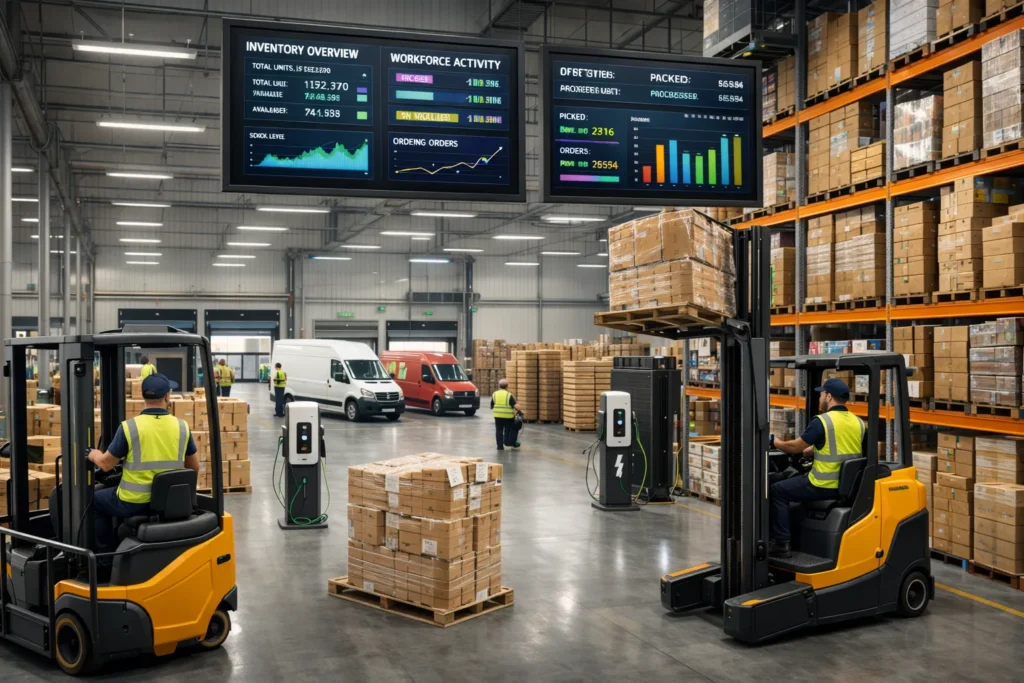
Labour availability remains one of the largest challenges in UK Warehousing and Distribution. The logistics sector faced an estimated 70,000 worker shortage in 2025, particularly for warehouse operatives and drivers.
Businesses address this issue through:
- automation investments
- workforce training programmes
- flexible shift scheduling
- productivity-focused warehouse design
These measures improve operational stability.
Rising Warehouse Costs
Warehouse rental costs have increased significantly due to demand. Prime UK logistics property rents rose 12.4% during 2024–2025, particularly in the Midlands logistics corridor.
Higher costs encourage companies to maximise warehouse space through vertical storage systems and inventory optimisation.
Sustainability and Environmental Targets
Sustainability now influences logistics planning. UK distribution operations increasingly adopt:
- solar-powered warehouse roofs
- electric vehicle fleets
- recyclable packaging systems
- energy-efficient lighting
These initiatives help companies meet environmental regulations and corporate sustainability goals.
Bottom Line
UK Warehousing and Distribution has evolved into a sophisticated logistics ecosystem supporting modern commerce. Warehouses now combine storage, automation, fulfilment, and transport coordination within integrated supply chains.
Strategic warehouse locations, advanced technologies, and data-driven operations allow businesses to deliver products faster and more accurately. Companies that invest in automation, efficient logistics networks, and sustainability initiatives will maintain a competitive advantage in the UK market.