

Table of Contents
UK Warehouse Safety Regulations form the backbone of safe and efficient warehousing operations across Britain. Warehousing employs more than 330,000 people in the UK logistics sector as of 2026, according to government labour data. However, the industry still records thousands of workplace incidents annually. The Health and Safety Executive (HSE) reported 138 worker fatalities across UK workplaces in 2024/25, with logistics and warehousing contributing a notable share of serious injuries.
Warehouse environments combine moving vehicles, heavy loads, automated systems, and high shelving. Without strict controls, these factors quickly increase accident risk. UK legislation, therefore, requires employers to implement risk assessments, staff training, equipment safety checks, and operational controls. These rules are reinforced by guidance such as the HSE Warehousing and Storage Safety Guide (HSG76).
Effective safety management protects workers, prevents operational disruptions, and reduces compliance penalties. Businesses that align operations with UK Warehouse Safety Regulations often see improved productivity and fewer lost workdays.
Understanding UK Warehouse Safety Regulations and HSE Requirements
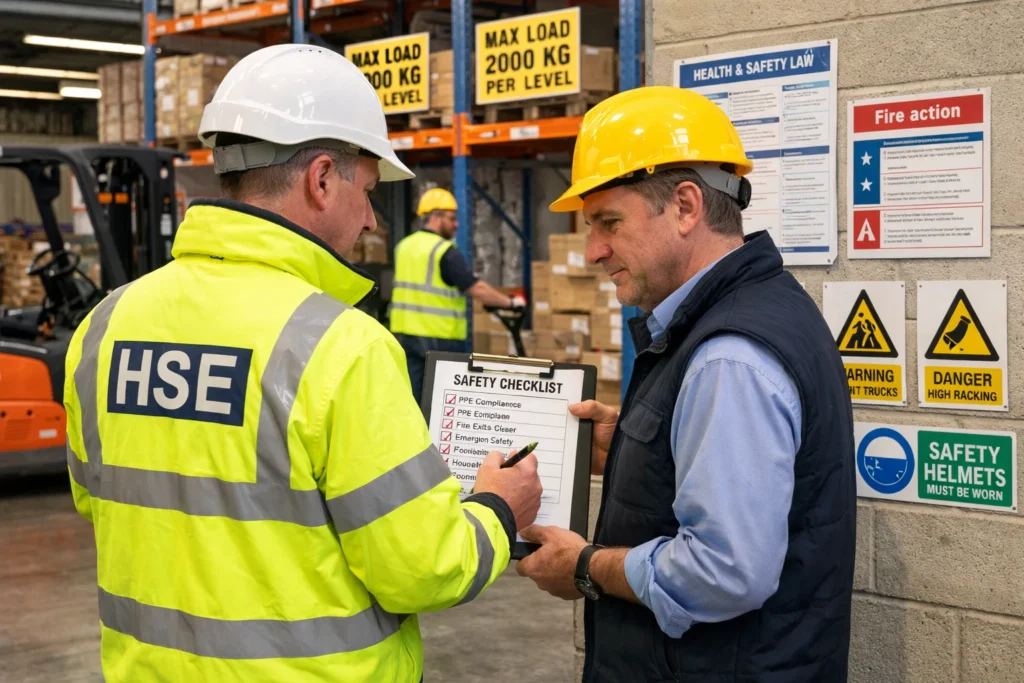
Legal Framework for Warehouse Safety
UK warehouse safety operates under several key laws and HSE guidelines. These regulations ensure employers maintain safe workplaces and reduce preventable incidents.
Key regulations include:
- Health and Safety at Work etc. Act 1974
- Management of Health and Safety at Work Regulations 1999
- Workplace (Health, Safety and Welfare) Regulations 1992
- Provision and Use of Work Equipment Regulations 1998 (PUWER)
- Manual Handling Operations Regulations 1992
These laws require employers to identify hazards, assess risks, train staff, and provide safe equipment. Failure to comply can result in fines, enforcement notices, or prosecution.
The HSE Warehousing and Storage Guide (HSG76) specifically addresses logistics environments. It covers traffic management, pallet storage safety, and employee training requirements.
Workplace transport accidents account for roughly 25% of all workplace deaths in the UK. This statistic highlights the importance of vehicle management in warehouses.
Clear compliance with UK Warehouse Safety Regulations protects both employees and business continuity.
HSE Inspection and Enforcement
HSE inspectors conduct workplace checks across UK logistics operations. Inspections may occur randomly or after incident reports.
Inspectors typically review:
- Risk assessments and safety documentation
- Staff training records
- Equipment maintenance logs
- Traffic management systems
- Accident reporting procedures
If hazards are identified, inspectors may issue Improvement Notices or Prohibition Notices. These orders require immediate corrective action.
Conducting Risk Assessments in UK Warehouses
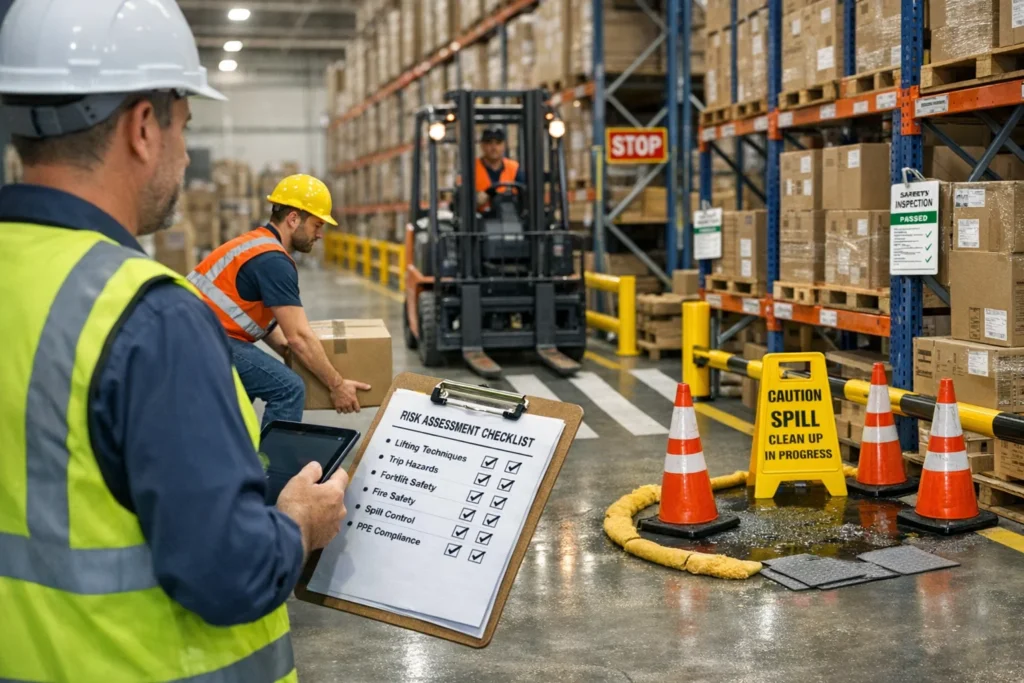
Five-Step Risk Assessment Process
Risk assessments form the foundation of UK Warehouse Safety Regulations compliance. HSE guidance at hse.gov.uk/simple-health-safety/risk outlines a clear five-step process.
- Identify hazards.
- Decide who may be harmed.
- Evaluate risks and implement controls.
- Record findings.
- Review assessments regularly.
This structured approach ensures warehouse managers identify potential hazards before incidents occur.
Common Warehouse Hazards
Modern warehouses combine manual labour and automated equipment. Both introduce unique safety risks.
Typical hazards include:
- Forklift vehicle collisions
- Falling objects from the racking
- Manual handling injuries
- Slips and trips on warehouse floors
- Conveyor system entrapment
- Fire hazards from stored materials
The HSE reports over 61,000 non-fatal workplace injuries in UK industries annually, with logistics contributing significantly.
Example Risk Assessment Table
| Hazard | Risk Level | Control Measures |
|---|---|---|
| Forklift traffic | High | Separate pedestrian walkways |
| Falling pallets | Medium | Racking inspections every 12 months |
| Manual lifting | Medium | Staff manual handling training |
| Wet floors | Low | Anti-slip flooring and signage |
Best Practices for Warehouse Safety Management
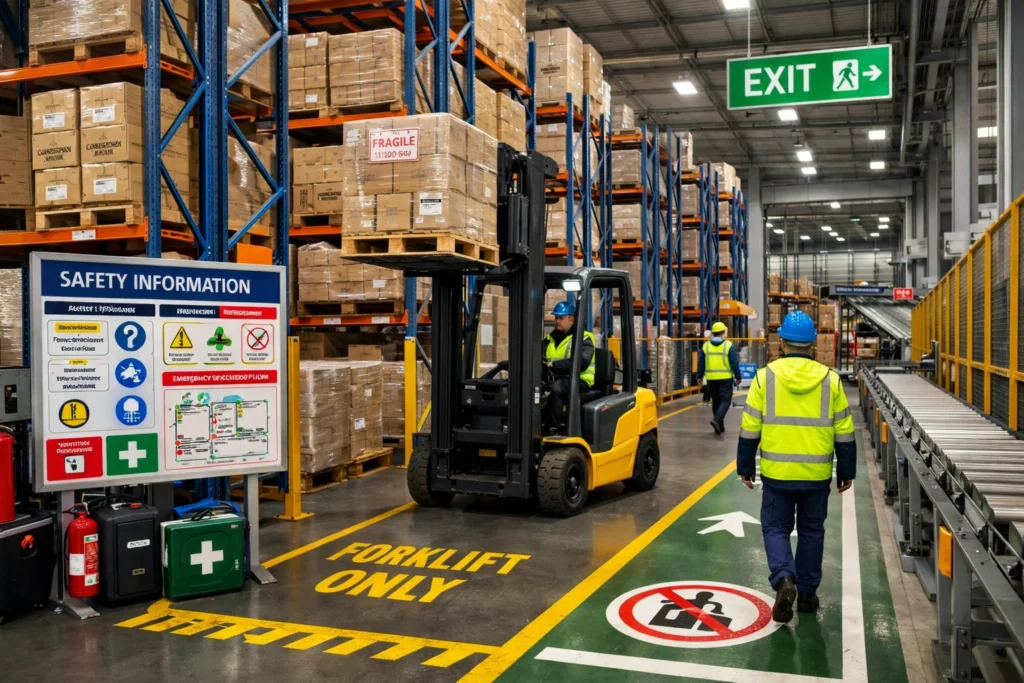
Traffic Management Systems
Vehicle movements represent one of the largest safety risks in logistics facilities. Effective traffic management significantly reduces accidents.
Best practice measures include:
- Clearly marked pedestrian walkways
- Speed limits within warehouse zones
- Dedicated loading bay traffic routes
- Forklift driver certification and refresher training
Many UK warehouses now install automated warning systems and proximity sensors to prevent collisions.
Traffic segregation alone can reduce workplace transport accidents by up to 40%, according to logistics safety studies referenced by HSE guidance.
Safe Storage and Racking Systems
Racking failures can cause catastrophic injuries and inventory losses. HSE guidance in HSG76 emphasises proper installation and routine inspections.
Key safety measures include:
- Load limits are displayed on all racking structures
- Annual inspections by qualified inspectors
- Immediate reporting of damaged pallets or racks
- Correct pallet stacking procedures
Warehouse managers should implement documented racking inspection schedules. This ensures structural integrity remains consistent across storage zones.
Employee Training and Safety Culture
Training remains one of the most effective accident prevention tools. Workers must understand equipment operation and hazard identification.
Essential training programmes include:
- Forklift operation certification
- Manual handling training
- Fire safety and evacuation procedures
- Emergency first aid awareness
Regular refresher training improves retention and reduces complacency. Warehouses that prioritise staff education often report fewer incidents.
Technology and Automation Safety
Automation is transforming UK logistics operations. Robotics, conveyors, and automated storage systems improve productivity.
However, automated equipment introduces new safety considerations.
Best practices include:
- Emergency stop systems on automated machinery
- Restricted access to robotic zones
- Sensor-based safety barriers
- Routine equipment maintenance checks
Automation must always operate within the framework of UK Warehouse Safety Regulations.
Key Warehouse Safety Checklist
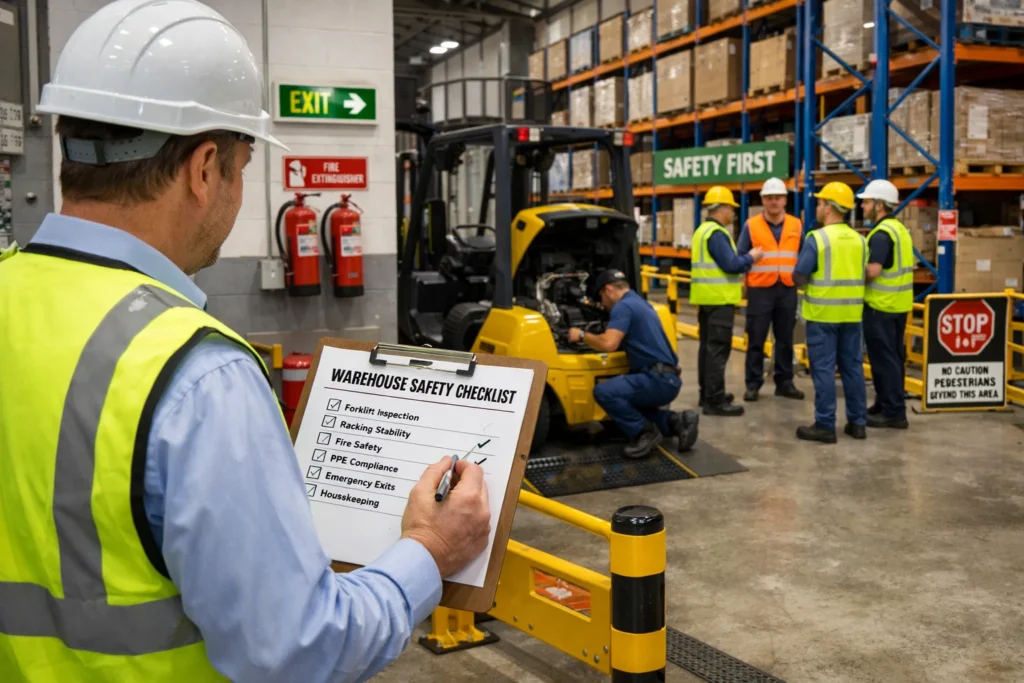
Warehouse managers should regularly review these safety practices:
- Conduct formal risk assessments every 12 months.
- Train all employees on hazard awareness.
- Inspect racking systems annually.
- Maintain forklift certification records.
- Implement traffic separation systems.
- Keep emergency exits clearly marked.
Bottom Line
Safe warehouse operations depend on consistent compliance with UK Warehouse Safety Regulations. These regulations combine legal obligations, structured risk assessments, and proactive workplace safety practices.
Modern logistics environments involve complex equipment, high storage systems, and constant vehicle movement. Without proper safeguards, these factors increase injury risks and operational disruption. Implementing HSE guidance, conducting thorough risk assessments, and training employees significantly reduces accidents.
FAQs
What are UK Warehouse Safety Regulations?
They are legal rules requiring safe warehouse operations, including risk assessments, training, and equipment safety compliance.
Who enforces warehouse safety laws in the UK?
The Health and Safety Executive (HSE) enforces workplace safety laws and conducts inspections.
How often should warehouse risk assessments be reviewed?
Risk assessments should be reviewed annually or after significant operational changes.
What is HSG76 in warehouse safety?
HSG76 is the HSE’s official guide for safe warehousing and storage operations.
What is the biggest warehouse safety risk?
Workplace transport accidents involving forklifts and vehicles remain the leading risk.