
Table of Contents
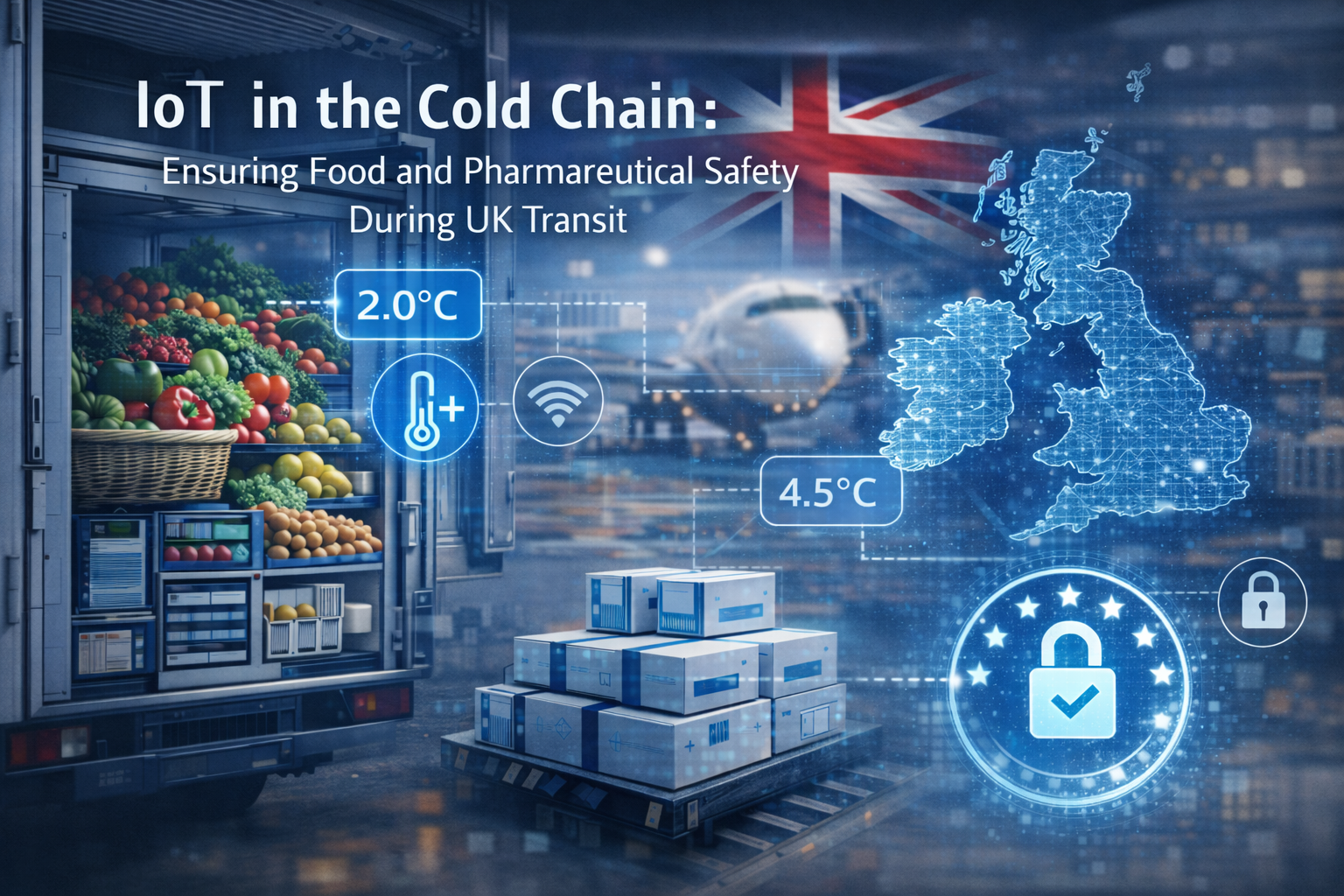
We start with a critical logistics trend: IoT in the Cold Chain is reshaping UK food and pharmaceutical transport. Cold chain logistics refers to the managed, temperature-controlled movement of perishables from origin to destination. The 2025 UK cold chain logistics market was valued at around USD 9.37 billion and is expected to grow to USD 11.55 billion by 2030. This reflects a growing need for visibility, traceability and regulatory compliance.
In the UK, food safety and pharmaceutical quality are enforced by strict regulation. Cold chain goods must maintain specific temperature ranges; failure to do so can cause spoilage or loss of drug efficacy. Industry adoption of IoT sensors, real-time monitoring and analytics is now vital to meet Good Distribution Practice (GDP) and public health standards.
Using IoT technologies, logistics operators gain continuous data on temperature, humidity, location and handling throughout transit. This improves compliance, reduces waste, and enhances supply chain resilience in a post-Brexit environment where traceability across borders is mandatory and an increasingly important factor in Reshaping UK Logistics.
Why IoT in the Cold Chain Matters for the UK Market

The UK cold chain logistics sector is expanding rapidly, driven by demand for temperature-sensitive food and medicine. Market research shows investment in IoT devices increases operational visibility and compliance with regulatory standards.
Real-time IoT monitoring can alert operators when temperature thresholds are exceeded, enabling instant corrective action. According to recent research, IoT sensors coupled with real-time analytics reduce spoilage and help fulfil quality targets.
This matters in the UK because logistics delays and regulatory checks at points of entry have increased since Brexit. Having connected sensors ensures data is logged consistently from the warehouse to delivery.
UK Regulations Driving IoT Adoption in Cold Chain Logistics
Good Distribution Practice (GDP) and UK compliance

UK pharmaceutical distribution must follow Good Distribution Practice, enforced by the MHRA. GDP requires products to be stored and transported at validated conditions with documented evidence of monitoring.
IoT systems simplify GDP compliance because they provide continuous temperature logs and automated alerts. This meets GDP’s requirement for “consistently stored and transported under suitable conditions”.
Similarly, food safety guidelines under UK law mandate that temperature-sensitive products are transported under controlled conditions. IoT devices that record and archive temperature readings help demonstrate compliance to enforcement officers.
Technology Stack: What IoT in the Cold Chain Looks Like Today
Sensors and Connectivity
IoT in cold chain typically includes wireless temperature sensors, GPS trackers and gateways that relay data to cloud platforms. This enables stakeholders to monitor conditions from origin to delivery.
Analytics and Predictive Alerts
Advanced systems use AI to forecast temperature excursions before they occur. Predictive analytics alerts operators to risks, reduces waste, and supports strategic decision-making, helping businesses more accurately forecast demand in the UK.
Integration with Blockchain and Traceability
Some UK firms combine IoT with blockchain to create tamper-proof records of product history. Research shows this enhances trust in perishable food and pharma logistics.
The Business Value of IoT in the Cold Chain for UK Logistics

Reducing spoilage and improving margins
Real-time monitoring cuts spoilage by identifying temperature issues early. This directly increases yield and reduces disposal costs.
Meeting consumer expectations
Consumers expect perfect food quality and safe drugs. IoT helps logistics providers offer transparency and reliability at every stage.
Enhanced competitiveness
IoT adoption is now a differentiator. UK operators who can offer digitally verified, temperature-assured logistics services gain a market advantage. Data from connected devices must integrate with WMS vs TMS software for UK logistics firms.
Case Study: IoT Improves Vaccine Distribution Integrity
In 2024, GlaxoSmithKline (GSK) implemented an IoT-based temperature-monitoring system for its UK vaccine logistics operations. With sensors on refrigerated vehicles and warehouses, GSK tracked temperatures globally in real time. The system reduced temperature excursions by 42 % over six months and improved audit readiness for MHRA inspections.
Data Table: Key UK Cold Chain IoT Metrics (2026)
| Metric | Value (2025–2026) |
|---|---|
| UK Cold Chain Logistics Market | USD 9.37 billion |
| Forecast CAGR (2025–2030) | 4.28 % |
| IoT Sensor Market Growth Trend | Increasing investment |
| Temperature Excursions Reduced | ~42 % with IoT |
| GDP Regulatory Inspections | Ongoing by MHRA |
Best Practices for Implementing IoT in UK Cold Chain Logistics

- Choose calibrated sensors: Annual calibration ensures reliability for regulated products.
- Automate alerting: Real-time alerts reduce manual oversight and response times.
- Integrate with ERP systems: Linking IoT data with logistics software improves compliance reporting.
- Plan for audits: Maintain archived logs for MHRA and food safety inspections without manual compilation.
Bottom Line
UK cold chain logistics is entering a new era where IoT in the Cold Chain is essential for food and pharmaceutical safety. Today’s regulatory environment incentivises real-time monitoring and the maintenance of auditable records to comply with GDP and food safety standards. The tangible benefits, reduced waste, lower operational risk, improved traceability and stronger customer trust, are driving widespread adoption. For UK operators, investing in IoT now is not an option but a strategic necessity that supports both compliance and competitive advantage.
FAQs
What is IoT in the cold chain?
A system of connected sensors that monitor temperature and conditions in cold logistics.
Why is IoT important for UK cold chain logistics?
It improves compliance, traceability and reduces spoilage.
Do UK regulations require IoT monitoring?
Regulations require continuous monitoring and documentation, which IoT supports.
What temperature range is critical for pharmaceuticals?
Most vaccines and drugs require 2–8 °C to remain effective.
Can IoT data help with MHRA inspections?
Yes, IoT logs provide auditable temperature records for compliance.
Disclaimer
This article is for informational purposes only. It does not constitute legal, regulatory, or operational advice for logistics or supply chain management.