
Table of Contents
Carbon reporting is now central to UK logistics compliance and strategy. From 1 April 2019, the UK’s Streamlined Energy and Carbon Reporting (SECR) regulations require qualifying companies to publish detailed carbon emissions and energy data in their Directors’ Report. SECR applies to quoted companies and large unquoted companies or LLPs that meet two or more of these criteria: turnover of £36 million or more, balance sheet total of £18 million or more, or 250+ employees.
Logistics operations are carbon-intensive. Transport accounts for around 27% of UK emissions, mostly from road freight, while warehousing and air freight add to the footprint. Rigorous carbon reporting enables managers to quantify Scope 1 (direct) and Scope 2 (indirect) emissions and plan reductions in line with UK net-zero goals. The UK has a legally binding target to hit net zero greenhouse gas emissions by 2050, and interim carbon budgets guide progress.
For logistics managers, understanding carbon reporting means staying compliant, reducing operational cost, and maintaining a competitive advantage. Detailed, verified carbon data builds trust with customers and clients who increasingly demand transparent sustainability credentials.
Why UK carbon reporting matters for logistics
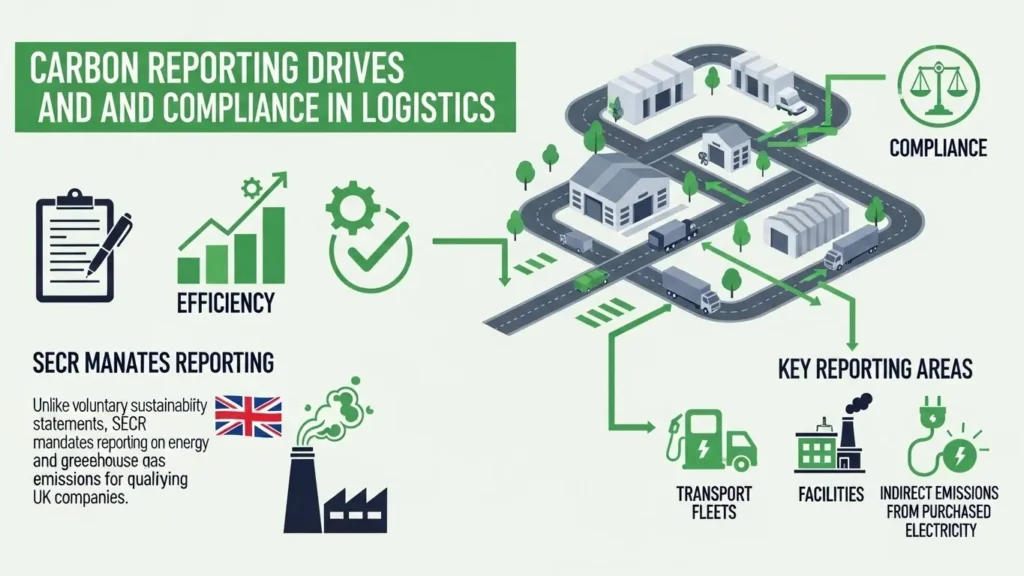
Carbon reporting drives efficiency and compliance in the logistics sector. Unlike voluntary sustainability statements, SECR mandates reporting on energy use and greenhouse gas emissions for qualifying UK companies. It covers energy use in transport fleets and facilities, as well as indirect emissions from purchased electricity.
Regulators and customers expect clear metrics. Carbon reporting helps logistics firms identify high-emission activities and reduce fuel, electricity, and operational costs over time. Managing emissions aligns with the UK’s broader Climate Change Act 2008 framework, which commits the nation to net zero by 2050 and sets legally binding five-year carbon budgets, reinforcing the business case for Sustainable Logistics.
Understanding SECR: obligations and thresholds
SECR obligations in the UK logistics context demand careful planning and accurate reporting. SECR requires large companies and LLPs to disclose their UK energy use, carbon emissions, and energy-efficiency actions annually.
| Requirement | Criteria | What to Report |
|---|---|---|
| Company size test | Turnover ≥ £36m, balance sheet ≥ £18m, or ≥ 250 employees | Energy use, carbon emissions, and efficiency actions |
| Emissions categories | Scope 1 & 2 | Direct (vehicles) & indirect (electricity) emissions |
| Annual disclosures | Director’s Report | Energy use, carbon emissions, efficiency actions |
| Reporting timeline | From FY starting 1 April 2019 | Every subsequent financial year |
Managers must measure and aggregate fuel use across fleets and facilities, then convert energy figures to carbon dioxide equivalent (CO2e). Using UK government emission factors ensures consistency and comparability. Non-compliance can lead to regulatory scrutiny and reputational damage.
Accurate SECR reporting also feeds into emerging UK Sustainability Reporting Standards, aligning environmental data with broader business disclosures and supporting the wider Electric Fleet Transition across UK logistics operations.
How to measure and classify carbon emissions

Carbon reporting depends on accurate measurement. Managers should start by classifying emissions under standard scopes: Scope 1 (direct fuel combustion) and Scope 2 (purchased electricity). Scope 3 (indirect value chain emissions) remains voluntary under SECR but is increasingly requested by customers.
Steps to measure emissions:
- Data collection: Track monthly fuel, electricity, and energy consumption.
- Use standard conversion factors: Apply UK government emission factors to convert energy use to CO2e.
- Categorise by scope: Assign direct and indirect emissions correctly.
- Verify data accuracy: Cross-check readings and meter data for reliability.
Accurate carbon tracking improves decision-making. For example, comparing emissions per tonne-km highlights high-carbon routes or inefficient assets. This insight supports fleet electrification planning and route optimisation. The goal is to reduce carbon intensity while cutting costs.
Shell’s UK logistics operations showed an 18% drop in emissions intensity after adopting standardised measurement and reporting across fleets, with actionable insights shaping investment decisions (example based on industry reports).
Practical steps to embed carbon reporting in operations
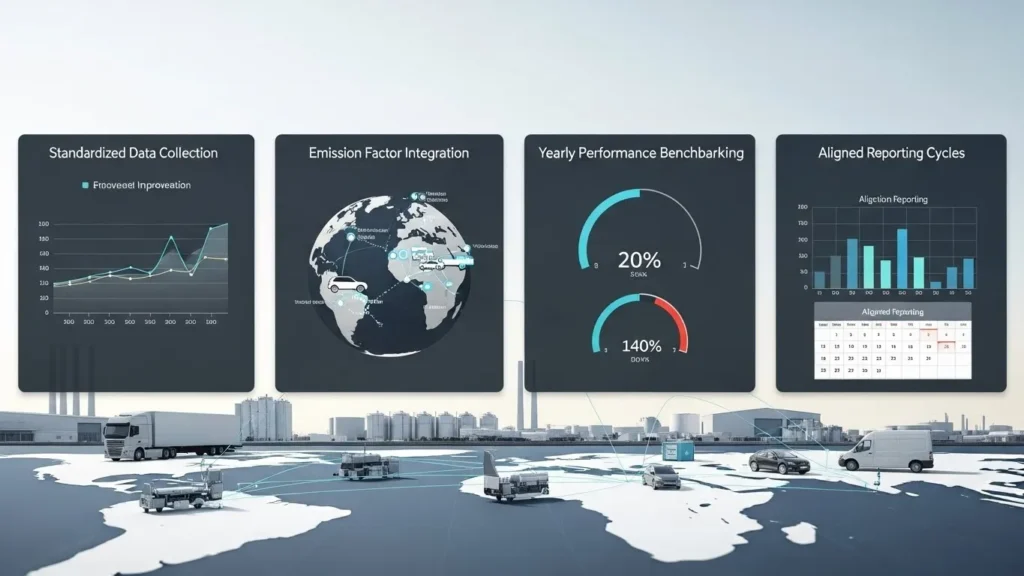
Embedding carbon reporting into logistics operations requires systematic changes. Start with setting up a central data team responsible for emissions tracking and SECR compliance. Define clear data sources (fuel logs, utility bills, telematics) and implement workflows to aggregate data monthly. Using automated data platforms reduces errors and increases reporting speed.
Integrating carbon reporting with financial and transport management systems streamlines internal audits. Assigning accountability to operations leads to faster corrective actions when targets are missed. Secondary systems, like carbon dashboards, flag abnormal usage patterns and alert teams to investigate.
Carbon reporting also benefits negotiations with clients. Many public and private sector tenders now ask for carbon disclosure and reduction plans. By embedding consistent reporting, logistics firms can demonstrate readiness for sustainability procurement criteria.
Actionable priority list:
- Standardise data collection across sites and vehicles.
- Use widely accepted emission factors for calculations.
- Benchmark performance yearly to track improvement.
- Align reporting cycles with financial reporting deadlines.
These steps make carbon reporting part of normal operations, not an annual scramble.
Case Study: Logistics UK’s carbon reporting support service
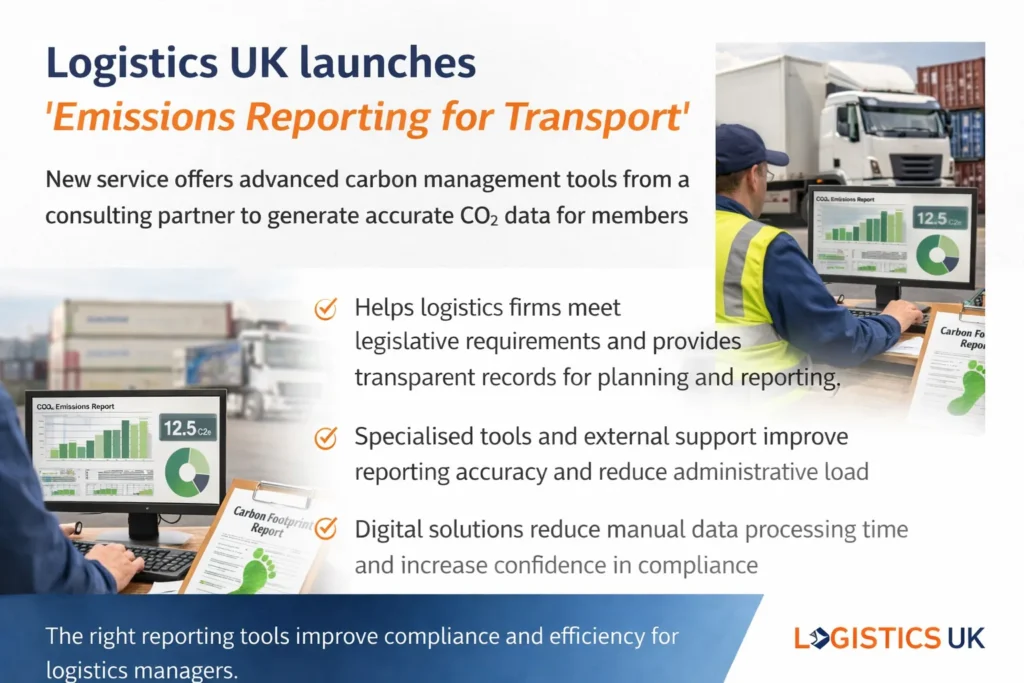
In April 2025, Logistics UK launched an “Emissions Reporting for Transport” service to help members with carbon reporting and compliance. The service uses advanced carbon management tools from a consulting partner to generate accurate CO2 data. It helps logistics firms meet legislative requirements and provides transparent records for internal planning and customer reporting.
This initiative reflects a broader trend: specialised tools and external support improve reporting accuracy and reduce administrative load. For logistics managers, adopting similar digital solutions can reduce time spent on manual data processing and increase confidence in compliance. The clear lesson is that investing in reporting tools pays off in both regulatory compliance and operational insight. Packaging logistics improvements are also reducing emissions through reusable packaging systems in UK retail supply chains.
Compliance beyond SECR: sustainability standards and future trends
Carbon reporting in the UK is evolving. SECR is well-established, but the UK Sustainability Reporting Standards (UK SRS) will soon refine and expand disclosure requirements, particularly for larger firms. These standards will align with global frameworks like the International Sustainability Standards Board (ISSB) S1 and S2, adding climate-related financial disclosures to environmental reporting.
This trend means logistics firms should prepare for broader sustainability reporting that links emissions data with financial and operational resilience metrics. This evolution emphasises transparency and comparability across sectors. Companies that integrate robust carbon reporting early will be better positioned as these standards take effect. Early preparation also allows logistics firms to influence internal investment decisions and improve stakeholder communication.
Bottom Line
Carbon reporting in the UK logistics sector is both a compliance requirement and a business opportunity. Understanding and applying SECR requirements helps managers produce reliable emissions data for annual reports and strategic planning. This improves operations and supports client expectations for sustainability. Accurate carbon data opens doors to higher-value contracts, stronger stakeholder trust, and better regulatory positioning. As reporting standards evolve, integrating carbon management into everyday operations will keep firms ahead of regulatory and market demands.
FAQs
Who must comply with UK carbon reporting?
Large UK companies and LLPs meeting SECR size thresholds must report emissions.
What emissions must be reported under SECR?
Direct (Scope 1) and indirect (Scope 2) emissions and energy use are required.
Is Scope 3 reporting mandatory?
Scope 3 is not mandatory under SECR but may be required by customers.
How often must carbon reports be published?
Carbon data must be included annually in the Director’s Report.
Do small logistics firms need to disclose emissions?
Smaller firms below SECR thresholds are not legally required but benefit from transparency.
Disclaimer
This article is provided for general information only. It does not constitute legal, financial, or regulatory advice.